

Reliable container test with artificial intelligence
Automatic visual inspection in the pharmaceutical industry

Industry: Filling systems in the pharmaceutical industry | Customer: Bonfiglioli Engineering S.r.l.
As a member of the TASI Group - the world's largest group specializing exclusively in leak testing, measurement and inspection - Bonfiglioli Engineering has been a provider of quality control solutions for all packaging requirements in the pharmaceutical, metal cans and aerosols, food and beverage, chemical and personal care sectors for more than 45 years.
Situation
In the pharmaceutical industry the combination options of containers, their materials, and contents are diverse. The contents or ingredients can be in powder or liquid form or lyo and arrive at the end consumer filled in ampoules, carpoules, vials, or ophtioles. But these containers must be checked for defects before they reach the consumer. Defects include foreign particles, cosmetic defects (scratches, deformations, etc.), incorrect fill levels or colors. The containers are generally made of glass, but the industry is increasingly relying on plastic, e.g. in the area of parenteral applications, i.e. the drugs are injected directly and not weakened via the gastrointestinal tract.
Challenge
Several challenges arise from the point of view of the inspection system. The following applies in order to overcome these challenges: Compared to glass, plastic containers have greater variability in terms of the light-visual properties and the analysis of the contents is made more difficult by the lower transparency. Secondly, they are less transparent, which makes it more difficult to analyze the contents. The variability generated by plastics means that a blob analysis which is normally used for classic, visual inspections with glass is not feasible. For this reason, tools are required which can learn to not only detect deviations, but also decide whether these are within limits or not.
Solution
Bonfiglioli Engineering recognized at an early stage that computer vision, a field within artificial intelligence (AI), is predestined for inspections in general and specifically for plastic containers. Computer vision is modeled on human vision, which has been trained over many centuries to distinguish, recognize, derive, and determine objects, distances, movements, and irregularities. With the aid of computer vision, machines should learn how to see, observe, and recognize like a human eye and thus be able to take measures and submit recommendations. Deep learning with neural networks is used specifically for this purpose. They learn how to distinguish between images and what content is displayed in an image at pixel level.
How does it work?
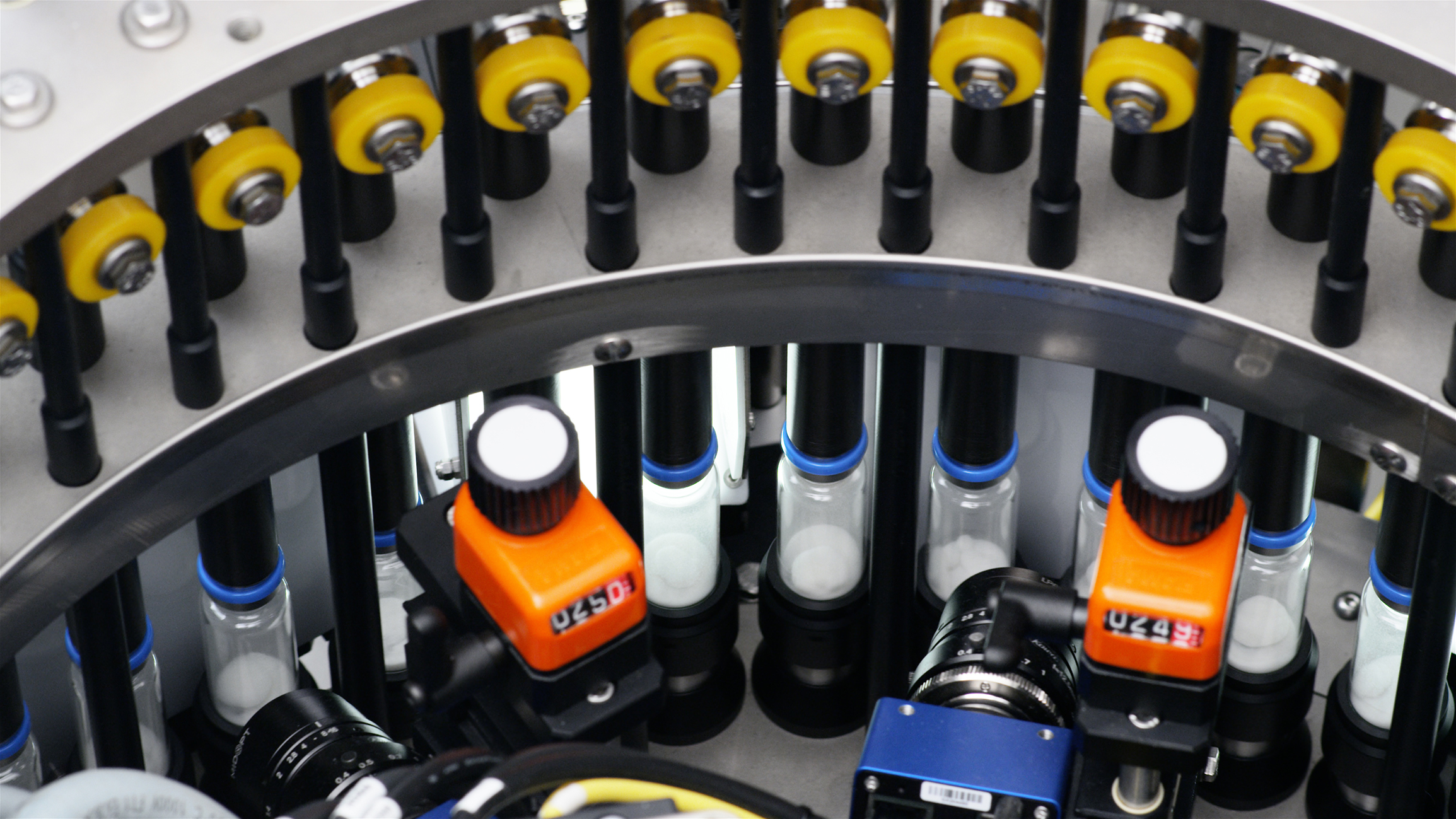
Large data volumes are required so that artificial intelligence can work. An inspection system in the pharmaceutical industry per se already generates plenty of image data. Defects in containers are determined by 360° imaging sequences with different light conditions. For example, in order to be able to determine foreign objects in a liquid, the container is set in motion in water, stopped abruptly, and the result is documented with a series of images.
In the case of powder or lyo content, the containers are rotated and images are taken at different stages during the rotation. Therefore, the image material should not be limited; the challenge lies in finding a camera that can take the required number of high-resolution images and deliver these to the host system, ideally edited.
Benefits
What are the most important features of your application?
- High-resolution image sensors
- FGPA (Field Programmable Gate Array)
- 256 MB image memory
- Smart Feature: Multi-AOI
- Smart Feature: Burst Mode
Products
In the search for a suitable camera, Bonfiglioli Engineering found the dual Gigabit Ethernet series BVS CA-GX2 which not only has a large selection of high-resolution sensors, but also an FPGA and 256 MB image memory. Both are required for a range of smart features which have proven to be essential for Bonfiglioli Engineering in order to meet the requirements of 400 CPM (Counts per Minute) and simple integration.
Twelve cameras in total are part of the "Automatic Visual Inspection System" (AVI) from Bonfiglioli Engineering. While ten cameras check whether there are defects such as crushing, flaws, color changes, particles or fill level defects inside the container, two cameras check whether there are defects on the outside of the container, especially at the cap or flip off.
Recommendations
Two smart features in particular were decisive: Firstly, the Multi-AOI supports the recording of different areas of the container with different exposure times and pieces them together into one image. Secondly, the Burst Mode enables images to be taken at the maximum sensor rate and transferred by buffers "loss free". As a result, Bonfiglioli Engineering was able to engineer an accurate and high-speed inspection solution. In addition, the MATRIX VISION cameras only require one Ethernet cable which simplifies cabling and integration.