

Do We Really Need to Complicate the Selection of Photoelectric Sensors?
A straightforward approach to choosing the right sensor – without over‑engineering.

Reading Time: minutes
Photoelectric sensors are essential components in conveyor automation. As devices become more feature rich, users face a growing question: how much functionality is truly necessary – and when does added complexity offer real value?
Rethinking Sensor Selection in Conveyor Automation
In modern conveyor systems, photoelectric sensors with extended functionality are increasingly common. They offer remote configuration, built‑in diagnostics, and digital communication options. While these features can simplify commissioning and maintenance, they also raise a fundamental question: are they required for every application?
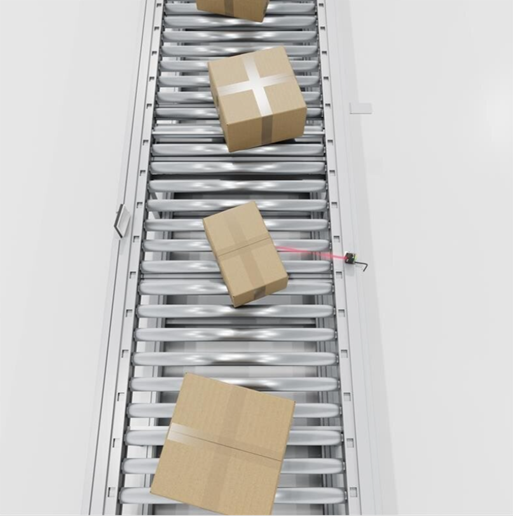
To explore this, it helps to consider a typical use case – carton detection on a conveyor.
Here, the core requirements remain straightforward:
reliable and stable detection
independence from object color and surface
simple installation and adjustment
quick replacement in the event of failure
These are characteristics that classic discrete sensors have traditionally delivered well.
When Added Features Come at a Cost
Advanced optical sensors provide useful capabilities, but they also introduce trade-offs.
Replacing or reconfiguring them often requires more specialized expertise compared to basic models, where rewiring and perhaps adjusting a potentiometer may be sufficient.
Costs accumulate at multiple levels:
Higher hardware price for the sensor
More expensive PLC interfaces, since digital or serial communication points can cost almost twice as much as standard discrete inputs
Additional software effort, particularly when integrating diagnostic data or parameter sets
In applications that deploy hundreds or thousands of sensors, these added costs become significant.
The Forgotten Parameter: Excess Gain in Real Conditions
Regardless of additional functions, one parameter remains fundamental: excess gain.
This optical reserve compensates for contamination, mechanical tolerances, and changing operating conditions. Specification values of 10 to 20 often sound impressive, but they only tell part of the story.
Excess gain must be considered together with optical alignment, because this is where issues often arise in real installations.
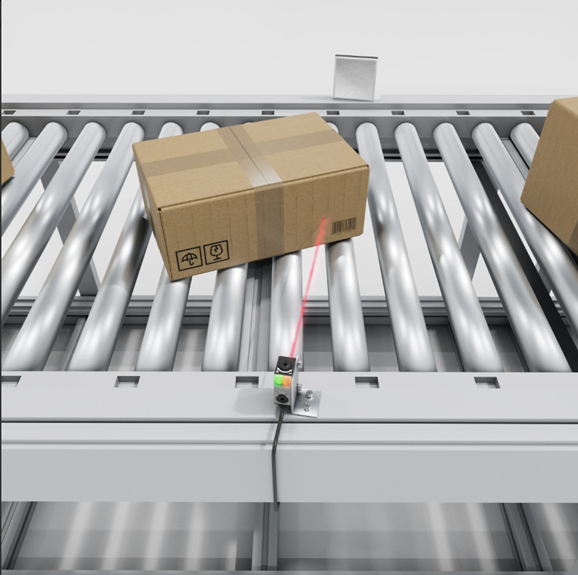
A frequently overlooked factor is the angular offset between the mechanical housing axis and the actual optical axis. Even a small deviation can lead to large practical consequences. For example, a 2° angular offset shifts the emitted light spot by around 35 mm at 1 meter.
With retro‑reflective sensors, the typical installation process is simple: the technician adjusts the position of the sensor or reflector until the sensor switches and then stops. This approach is common and intuitive, but it hides a crucial issue: the switching point alone does not guarantee optimal optical alignment.
A sensor with a significant axial or angular offset may still switch reliably during installation, even though:
the emitter beam no longer hits the center of the reflector, and
the return beam no longer aligns with the receiver optics.
When this happens, the sensor technically operates, but under degraded optical conditions. A large share of the reflected light never enters the receiver lens and is instead lost at the aperture or within the optical path.
The result is a measurable deterioration of key performance parameters:
reduced effective excess gain
lower switching reliability, particularly under contamination or vibration
greater sensitivity to dirt and build‑up
higher vulnerability to small mechanical shifts
In practice, this means that even sensors equipped with extensive features can underperform simply because the optical path is not optimally aligned, despite the technician seeing a switching signal and assuming everything is correctly set.
Balancing Real Needs and Functional Overload
Complex sensors can be justified, but only when the application truly benefits from them.
Diagnostic features may be useful in systems where machine availability is critical, or where failure detection and predictive maintenance are part of the operational strategy.
However, in many standard object‑detection tasks across logistics, conveyor lines, or automated storage systems, the priorities are different.
What delivers the most value is often:
a robust optical parameters
high excess gain
simple setup and maintenance
consistent detection performance
Systems that rely on large numbers of sensors especially benefit from these characteristics, because lower complexity means lower total cost of ownership and less operational dependency on specialized personnel.
Conclusion
Selecting the right photoelectric sensor requires differentiation, not complication.
For majority of standard detection tasks:
Simple discrete sensors with strong optical performance often remain the most effective and economical solution.For some of critical or availability‑relevant applications:
Sensors with diagnostic and communication features may be worthwhile, provided their added cost and complexity translate into measurable operational value.
In other words: start with the core optical principles, then evaluate whether additional functionality truly contributes to performance, reliability, or system efficiency.
If you're looking for the right automation solution, check out our BOS Entry Line now!

Comment
Popular posts
An easy way to remember PNP and NPN sensor wiring
The evolution of inductive sensor technology
Choosing the right code reader: Laser versus vision
Balluff's Long Distance Positioning System (LDPS): An ultimate in reliability and flexibility
Contact form
Do you have any questions or suggestions? We are at your disposal.
Balluff Benelux
-
Hintham 117d
5246 AE Rosmalen, Netherlands