

Condition Monitoring in Practice – Real Benefits Backed by Data
Why condition monitoring is becoming a critical driver of reliable production.
Reading Time: minutes
This means that over 60% of plants still operate reactively or rely solely on preventive maintenance, even though technical data is often already available. As a result, they face unplanned downtime, premature component replacement, and higher maintenance costs.
From potential to measurable results – what does condition monitoring deliver in practice?
The low adoption rate of condition monitoring is not due to lack of benefits, but rather concerns about complexity and implementation costs. In reality, plants already using machine condition monitoring show that even simple, scalable solutions can generate fast and measurable results. Condition monitoring impacts not only failure reduction but also service costs, product quality, and energy efficiency.
Below are 8 key benefits of condition monitoring, illustrated with practical examples and real industrial data.
1. Eliminating sudden, unplanned downtime
One of the biggest advantages of condition monitoring is the ability to detect early signs of failure before they lead to production stoppages.
Use case: 6‑month pump monitoring
A customer using the CMTK system was able to predict a failure 30 days in advance by analyzing vibration trends:
15.05 – linear vibration increase, exceeding 1 mm/s
05.06 – stable exceedance above 1.5 mm/s → decision to schedule downtime in 5-7 days
10.06 – trend shifts from linear to exponential → critical 48 h
13.06 – controlled shutdown and pump replacement
After replacement, vibration dropped to 0.25 mm/s, and production continued without an uncontrolled stop.
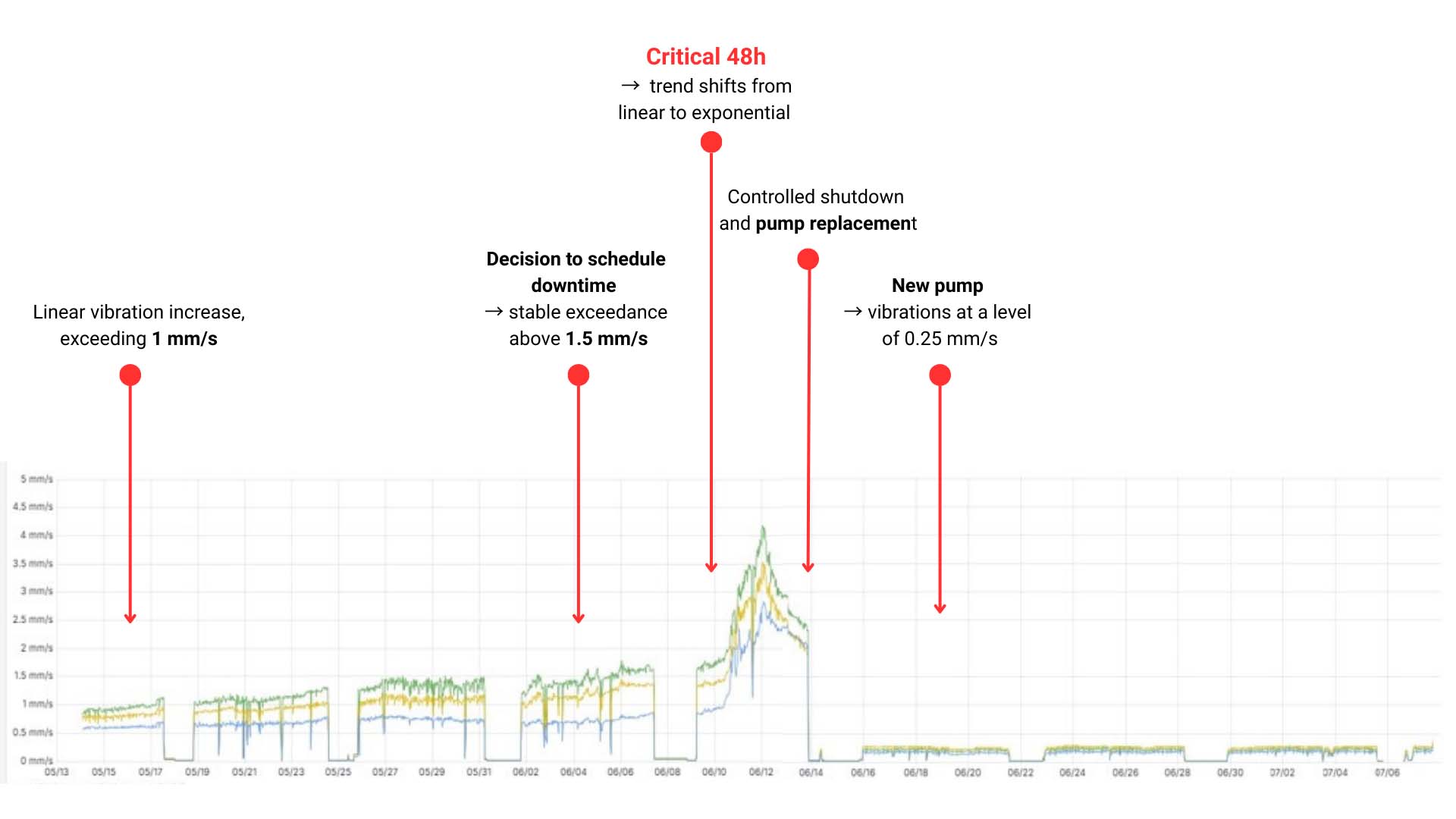 Predicting Pump Failure Using Vibration Trends - 30 Days in Advance with CMTK
Result:
✔ no failure during the production cycle
✔ planned service downtime instead of emergency stop
✔ avoided downtime costs and production losses
2. Full utilization of component lifetime
In preventive maintenance, components are often replaced too early “just in case.” Condition monitoring enables maintenance decisions based on actual machine condition, allowing full lifetime utilization without increasing failure risk.
Example: bearings
preventive replacement: ~70% of lifetime used
predictive replacement (CM): 100% of lifetime used, exactly at the optimal moment
Result:
✔ fewer replacements
✔ lower spare parts costs
✔ reduced maintenance workload and better downtime planning
3. Extended overhaul intervals and real cost savings
Condition monitoring not only prevents failures—it enables machines to run longer between overhauls without compromising safety or reliability.
Use case: extruder motor
Continuous vibration monitoring allowed early detection of degradation and postponement of the overhaul.
interval between overhauls: extended from 24 to 38 months
overhaul postponed by 14 months thanks to trend analysis
Cost comparison for 1 machine
2-year period:
preventive: 18 666 PLN ~4 418 €
predictive (CMTK): 10 500 PLN ~2 485 €
5-year period:
preventive: 46 666 PLN ~11 045 €
predictive (CMTK): 26 250 PLN ~6 214 €
Result:
✔ fewer, better‑timed overhauls
✔ significantly lower maintenance costs
✔ for 5 machines: over 23 670 € saved over 5 years (100 000 PLN)
4. Optimizing spare parts inventory
Without machine condition data, companies tend to overstock spare parts “just in case.” Condition monitoring enables a just‑in‑time approach.
Result:
✔ less capital tied up in spare parts
✔ better purchase planning
✔ fewer obsolete components on shelves
5. Improved final product quality
Worn mechanical components - bearings, shafts, pumps - affect not only breakdown risk but also process stability and product quality. As machine condition worsens, scrap and customer complaints often rise well before an actual failure occurs.
Use case: production with vs without prediction
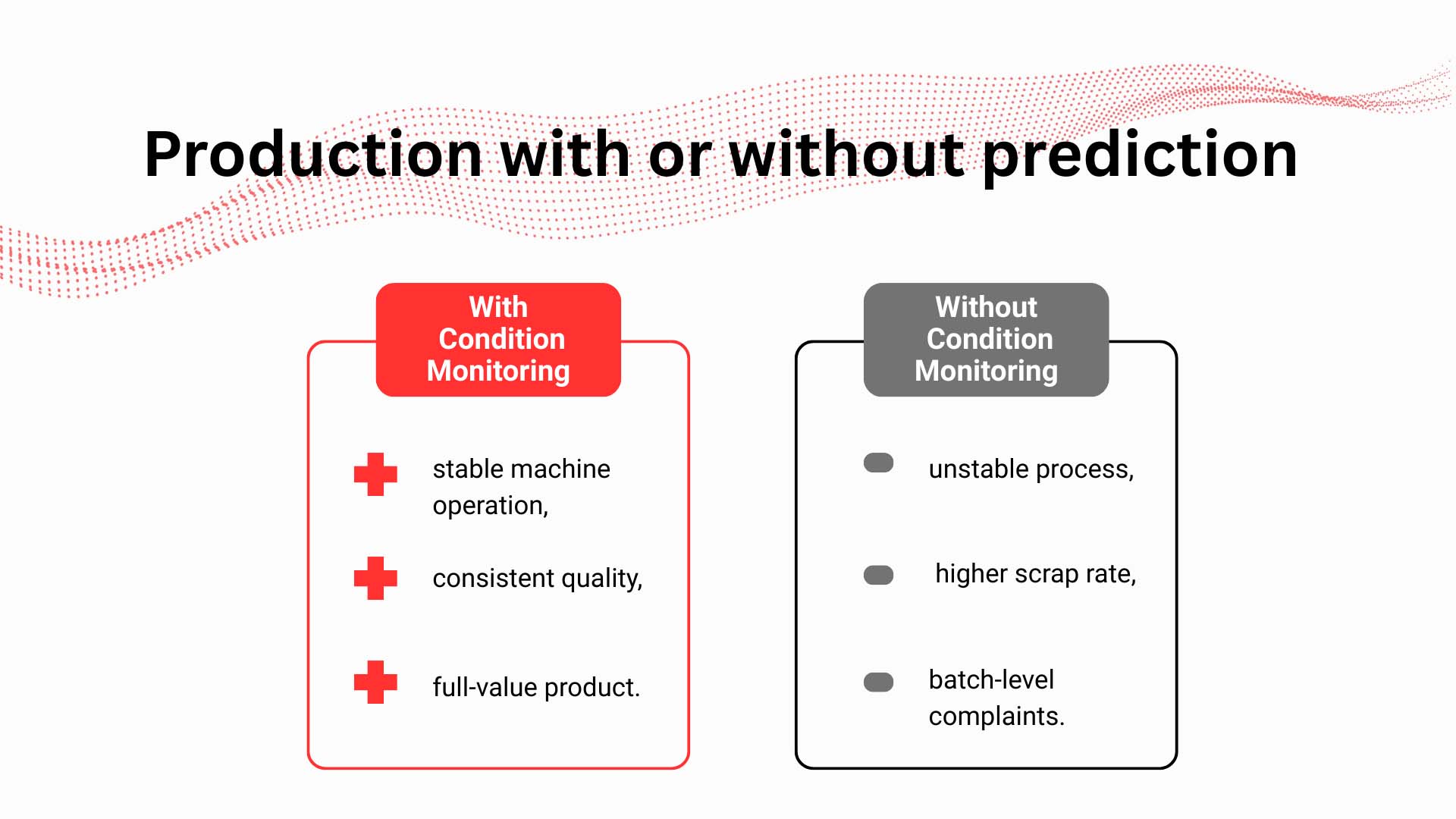 In one case, lack of prediction resulted in:
€25,000 loss due to scrapped material
batch complaint and loss of customer trust
Condition monitoring enabled early detection, avoided failure, and eliminated complaint costs.
6. Increased energy efficiency
Machines in poor technical condition consume more energy. Monitoring vibration, temperature, and electrical parameters keeps equipment at its optimal operating point.
Result:
✔ lower energy consumption
✔ reduced mechanical losses
✔ support for ESG and energy‑cost reduction goals
7. Low entry threshold and system scalability
Implementation cost is often mentioned as a barrier. Modern solutions like Balluff CMTK eliminate this issue:
start with just 1 measurement point
scale to dozens or hundreds
unit cost decreases with scale
Example
1 point: even the base setup costs roughly as much as a one‑day visit of an authorized service technician
4 points: unit cost drops by 54%, as the central unit cost spreads across more sensors
44 points: lowest cost per point
8. Easy integration and fast commissioning
CMTK is designed for quick, straightforward deployment—no lengthy configuration or advanced analytics knowledge required.
CMTK provides:
ISO‑based configuration wizard
automatic alarm threshold selection
integration with SCADA and higher‑level systems (OPC UA, MQTT, databases like InfluxDB)
With IO‑Link, it supports easy integration of sensors such as:
vibration
temperature
pressure
electrical energy
process media (air, liquids)
analog sensors
Result: fast startup, easy scaling, and full compatibility with existing automation infrastructure.
🔎 Check out Balluff's complete solutions: Monitoring | Balluff
Summary: fast impact, measurable ROI
Condition monitoring is now one of the fastest ways to improve production efficiency. These examples clearly show that monitoring machine condition helps avoid unplanned downtime, fully utilize component lifetime, and significantly reduce maintenance costs—often within the first months.
Thanks to scalable solutions like Balluff CMTK, condition monitoring doesn't require large investments or complex projects. Companies can start with a single machine or measurement point and expand as needed.
This is not “future technology.” It's a proven, available‑today tool that directly increases machine availability, stabilizes production quality, and delivers measurable savings. Companies adopting condition monitoring now gain an advantage in a market where most still operate reactively.
Author

Balluff EMEA
We are your partner for innovative solutions in industrial automation. With our passion we improve your competitive position with speed and results. With our 100 years company history and more than 60 years of sensor experience, Balluff is a world leader and one of the most efficient manufacturers of sensor technology.
17 Contributions
Comment
Popular posts
Sensors for Detecting Transparent Media
An easy way to remember PNP and NPN sensor wiring
5 facts about IO-Link
BCM - a sensor that detects anomalies
Contact form
Do you have any questions or suggestions? We are at your disposal.
Balluff AB
-
Gamlestadsvägen 2, B19
415 11 Göteborg