

Driving Innovation with Digital Twins: My Journey at Balluff
Creating digital twins of our hardware components

Reading Time: minutes
Hello, my name is Philippe Komma, and I work as a Platform Architect at Balluff , where I focus on Industry 4.0 topics such as the Industrial Internet of Things (IIoT) and digital twins. My role involves driving the global rollout of these cutting-edge technologies across the company. Over the past two years, I’ve had the privilege of working on an exciting initiative: creating digital twins of our hardware components.
In this blog, I’d like to share insights into our journey with digital twins, their role in virtual commissioning, and the partnerships that have helped us bring this vision to life.
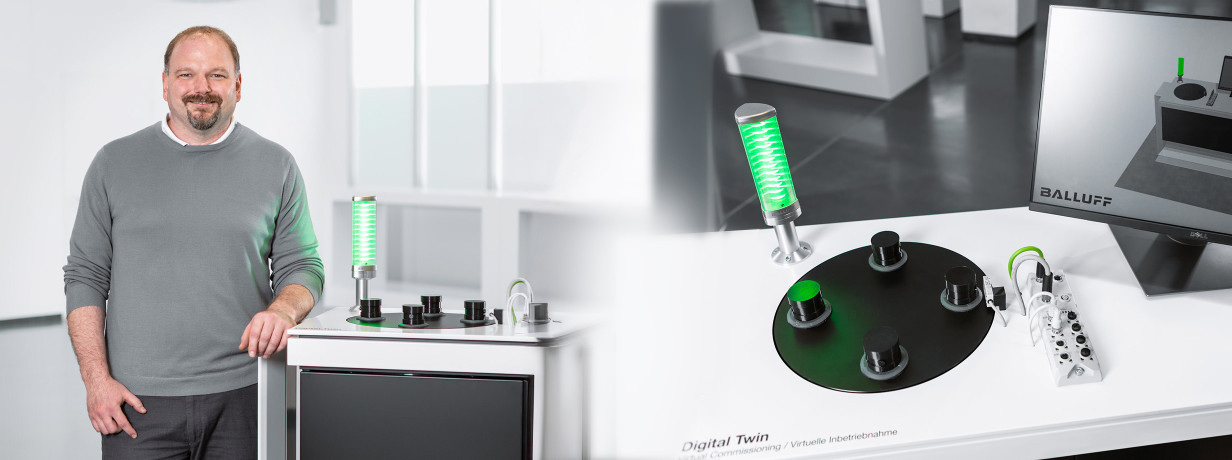
What Are Digital Twins?
At Balluff, we define a digital twin as a piece of software that mirrors the behavior of its physical counterpart. In our context, this means creating a virtual version of a hardware component that interacts with a Programmable Logic Controller (PLC) in the same way as the physical device.
For example, in a hardware-in-the-loop environment, the digital twin receives control commands from the PLC, processes them, and sends result messages back—just as the physical hardware would. The PLC cannot distinguish whether it’s communicating with the physical device or the digital twin.
This capability is particularly valuable for our customers, who use digital twins in the context of virtual commissioning.
What Is Virtual Commissioning?
Virtual commissioning is a process that allows manufacturers to test and validate their machines or systems in a virtual environment before they are physically built. By simulating the behavior of machines, systems, and components, virtual commissioning enables engineers to identify and resolve potential issues early in the development process.
Benefits of Virtual Commissioning:
Reduced Time-to-Market: By identifying and fixing issues virtually, manufacturers can avoid costly delays during physical commissioning.
Cost Savings: Virtual testing reduces the need for physical prototypes, saving material and labor costs.
Improved Quality: Engineers can optimize system performance and ensure seamless integration of components before production begins.
Increased Flexibility: Changes to the design or system can be tested and implemented quickly in the virtual environment.
For our customers, digital twins are a critical part of this process. They allow our components to be seamlessly integrated into their virtual machine simulations.

The Role of Digital Twins in Virtual Commissioning
At Balluff, our components form the smallest building blocks of our customers’ machines and systems. To fully model their machines in a simulation, our customers need virtual counterparts of our components—this is where our digital twins come in.
Our digital twins are integrated into a simulation framework that replicates our customers’ machines or entire systems. This framework is a highly complex application provided by our strategic partner, ISG Stuttgart.
Collaboration with ISG Stuttgart
ISG Stuttgart is a leading provider of simulation and automation solutions. The company specializes in developing software for virtual commissioning, real-time simulation, and digital twins. Their flagship product, ISG-virtuos, is a powerful simulation platform that enables manufacturers to create virtual models of machines and systems.
ISG Stuttgart has been an invaluable partner in our digital twin journey. They supported us during the initial stages of development, helping us integrate our digital twins into their simulation framework. Over the past two years, we’ve built a strong and constructive partnership with ISG Stuttgart, and their expertise has been instrumental in our success.
Testing with BBS Automation
Another key partner in our digital twin initiative is BBS Automation, a global leader in automation solutions. BBS Automation specializes in designing and building custom automation systems for a wide range of industries, including automotive, medical, and consumer goods.
BBS Automation has supported us by testing our digital twins in real-world scenarios. Their feedback has been invaluable in refining our solutions and ensuring that our digital twins meet the highest standards of performance and reliability. In fact, our digital twins have already been successfully deployed in their virtual commissioning processes.
Expanding the Scope of Digital Twins
The success of our digital twin initiative has sparked interest across Europe. Customers are increasingly recognizing the value of digital twins, particularly for more complex components such as our Smart Light, magnetostrictive position measuring systems, and network modules.
I’m excited to see this growing enthusiasm and look forward to collaborating with our customers to develop customized digital twin solutions that meet their unique needs.

Looking Ahead
The journey of creating and deploying digital twins has been both challenging and rewarding. It’s exciting to see how this technology is transforming the way our customers design, test, and commission their machines and systems.
At Balluff, we remain committed to driving innovation in Industry 4.0 and supporting our customers with cutting-edge solutions. I’m proud to be part of this journey and look forward to continuing to explore the possibilities of digital twins and virtual commissioning.
If you’re interested in learning more about our digital twin solutions or have specific requirements, feel free to reach out. Let’s shape the future of manufacturing together!
Watch our test at BBS Solution on YouTube:
Keywords
- Digital Twins
- Industrial Automation
Author

Philippe Komma
0 Contributions
Comment
Popular posts
Sensors for Detecting Transparent Media
An easy way to remember PNP and NPN sensor wiring
5 facts about IO-Link
BCM - a sensor that detects anomalies
Contact form
Do you have any questions or suggestions? We are at your disposal.
Balluff AB
-
Gamlestadsvägen 2, B19
415 11 Göteborg