

Smart Manufacturing: it’s all about the data
How smart sensors, networking, and software/AI handle data to transform manufacturing efficiency
Reading Time: minutes
Manufacturers today are under constant pressure. Costs are rising, supply chains are shifting, customer expectations are increasing, and production environments are becoming more complex. At the same time, resources—people, time, and equipment—are stretched thinner than ever.
So how can manufacturers do more with less? Increasingly, the answer is smart manufacturing—and at its core, smart manufacturing is all about more effectively gathering and using data. For many manufacturers, the challenge isn’t a lack of data—it’s knowing how to access it, trust it, and use it effectively.
One of the most common ways manufacturers use this data is to measure performance with Overall Equipment Effectiveness (OEE), which looks at three key areas:
Availability: Improve asset utilization & machine availability
Performance: Reduce unplanned downtime & small stops
Quality: Reduce scrap rates & improve quality
Monitoring, managing, and improving these components is enabled by smart manufacturing, which uses data generated, gathered and handled by technologies such as robotics/automation, smart devices, networking/IIoT, and software/AI/the cloud. These technologies give manufacturers the process visibility, flexibility, and efficiency needed to increase OEE.
Visibility: the ability to securely see what’s happening on a machine, process and facility in locations ranging from the shop floor to remote office.
Flexibility: the ability to quickly adjust production to changing customer demand, process bottlenecks, and high mix/low volume production.
Efficiency: the ability to reduce unplanned downtime by anticipating equipment failures and allowing faster diagnosis/troubleshooting.
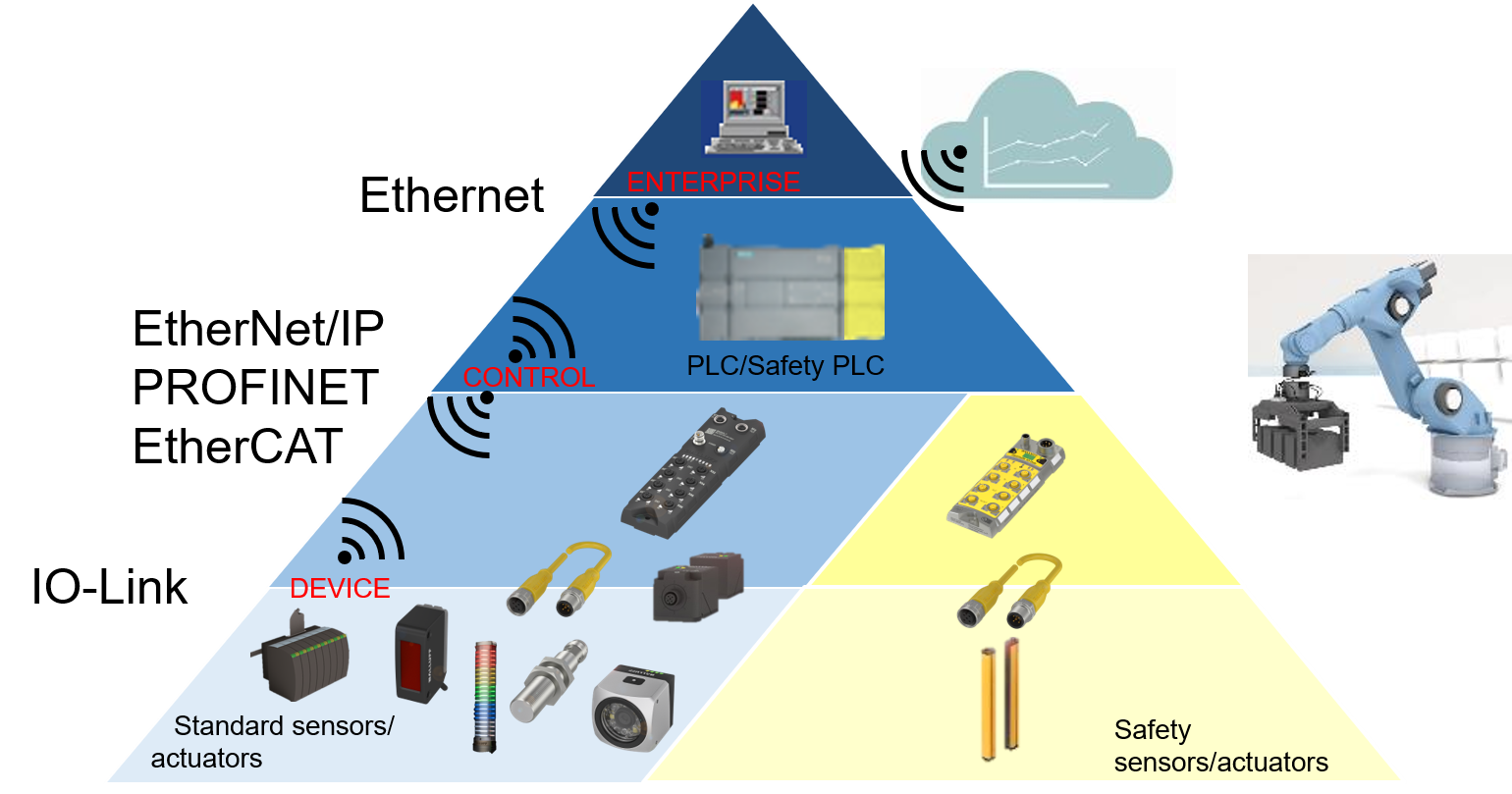
Data is the critical element for these, and advanced sensors provide more than simple on/off or analog signals. For example, smart sensors with the IO-Link protocol can provide:
Process Data: the state of a device or measurement values
Service/Parameter/Device Data: parameter values and configuration settings, and non-time critical values such as operating cycles or hours
Event Data: infrequent events such as alarms or information messages
This additional context helps manufacturers not only run machines, but also understand their condition, performance, and potential issues.
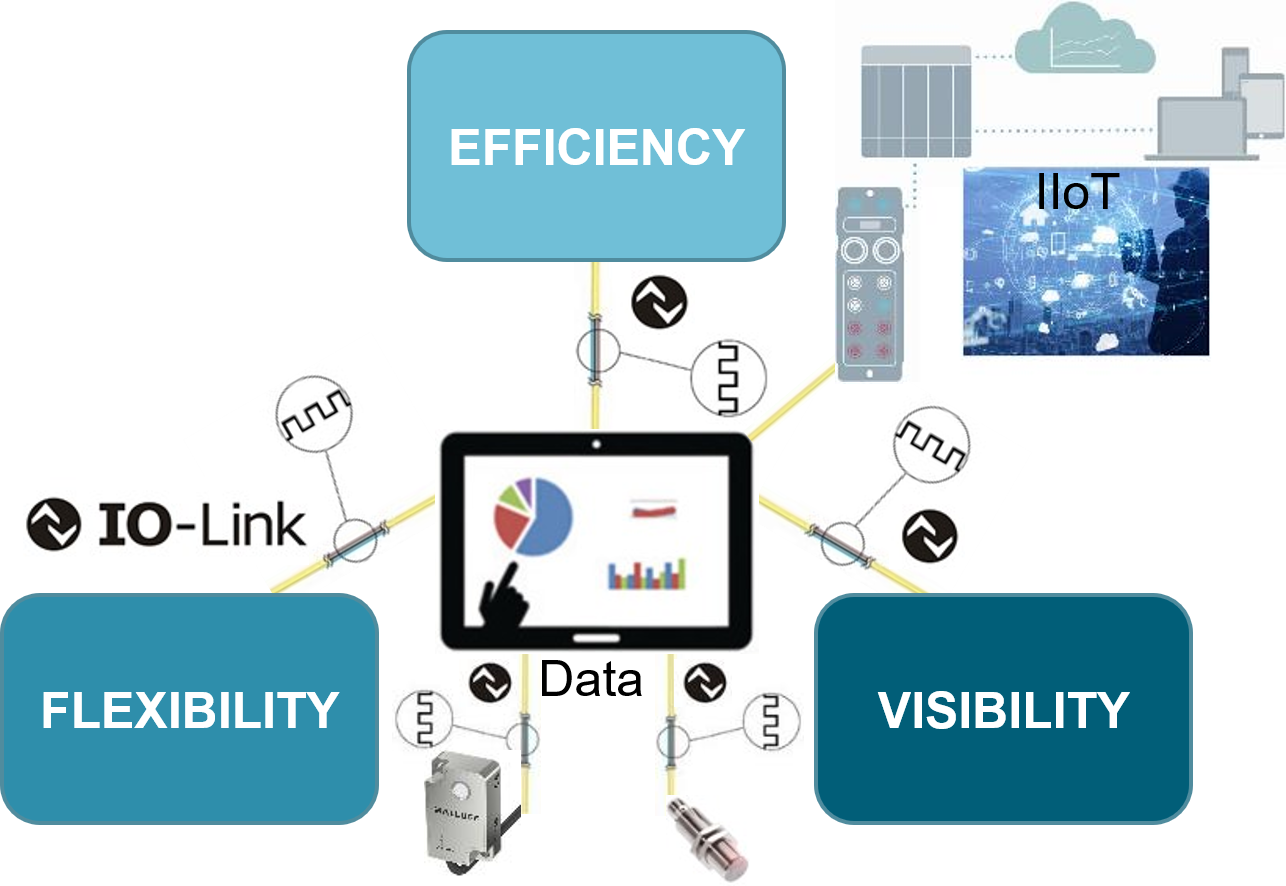
In a smart factory, the data is generated directly on factory floor equipment by a variety of sensors. The data is then moved to network blocks using device level protocols such as IO-Link. These network blocks consolidate the data to then move it to control systems using industrial Ethernet protocols, and the data can be moved to enterprise level systems or the cloud using standard Ethernet protocols.
Different protocols are used to communicate data between different levels for a variety of reasons:
Device-level protocols are excellent for moving the relatively small amounts of data generated by sensors quickly and cost-effectively to the control level. The hardware is robust and small enough to fit in small devices and avoids using scarce IP addresses, some protocols provide advanced data (example: IO-Link provides process, service, and event data).
Industrial Ethernet protocols are a great fit for moving larger amounts of data at high speeds between devices on the control level and to factory management systems. They provide a level of robustness necessary for the harsh factory environment. If necessary, there are very fast protocols for real-time control (example: EtherCAT for motion control).
Standard Ethernet protocols are often used for connection between the control and enterprise levels, or the cloud, where more advanced, less time critical data processing of “big data” can take place.
The important thing is that the data created on the factory floor equipment can be quickly, efficiently and cost-effectively moved to where it’s needed – often the same data can be used for multiple purposes. For example, data from a sensor on a conveyor might control machine operation in real time, provide visualization for operators, and feed data into a system that tracks uptime and performance.
The glue that binds the elements of smart manufacturing together is data. Smart devices, along with networking/IIoT, robotics/automation, and software/AI/the cloud, enable manufacturers to capture, move, and use this data effectively to improve OEE, reduce downtime, and make better decisions. As manufacturing continues to evolve, those who can turn machine data into actionable insight will be best positioned to stay competitive.
Keywords
- Industrial network technology
- IO-Link
- Efficient production
- Industry 4.0
- Sensor technology
- Robotik
- The basics of automation
- Industrielle Automatisierung
- Trends in der Technologie
- Intelligente Sensorik
- IoT
Author

Tom Knauer
Tom Knauer has more than 30 years of industrial automation experience and has presented on condition monitoring and smart manufacturing/IIoT at the Automate Conference, the Assembly Show, IMTS and IME West.
0 Contributions