

Continuous production monitoring in folding machines
Don't miss a thing with high-speed cameras

Industry: Folding machines in the printing industry | Customer: MBO Postpress Solutions GmbH
MBO Postpress Solutions GmbH as part of the Komori Group produces machines in the field of print finishing, which cover individual requirements and lead to optimizations and performance increases of folding processes.
Situation
When specifying the Le Mans high-speed folding system, the focus was on speed and ergonomics. With a folding volume of approx. 70 million printed sheets and more per year or 23,000 sheets per hour as a maximum (folded as 16-page A4), the system reaches speeds at which it is necessary to enclose it to such an extent that any danger to the operator can be ruled out. However, this makes it difficult for the operator to adjust and check the products.
Challenge
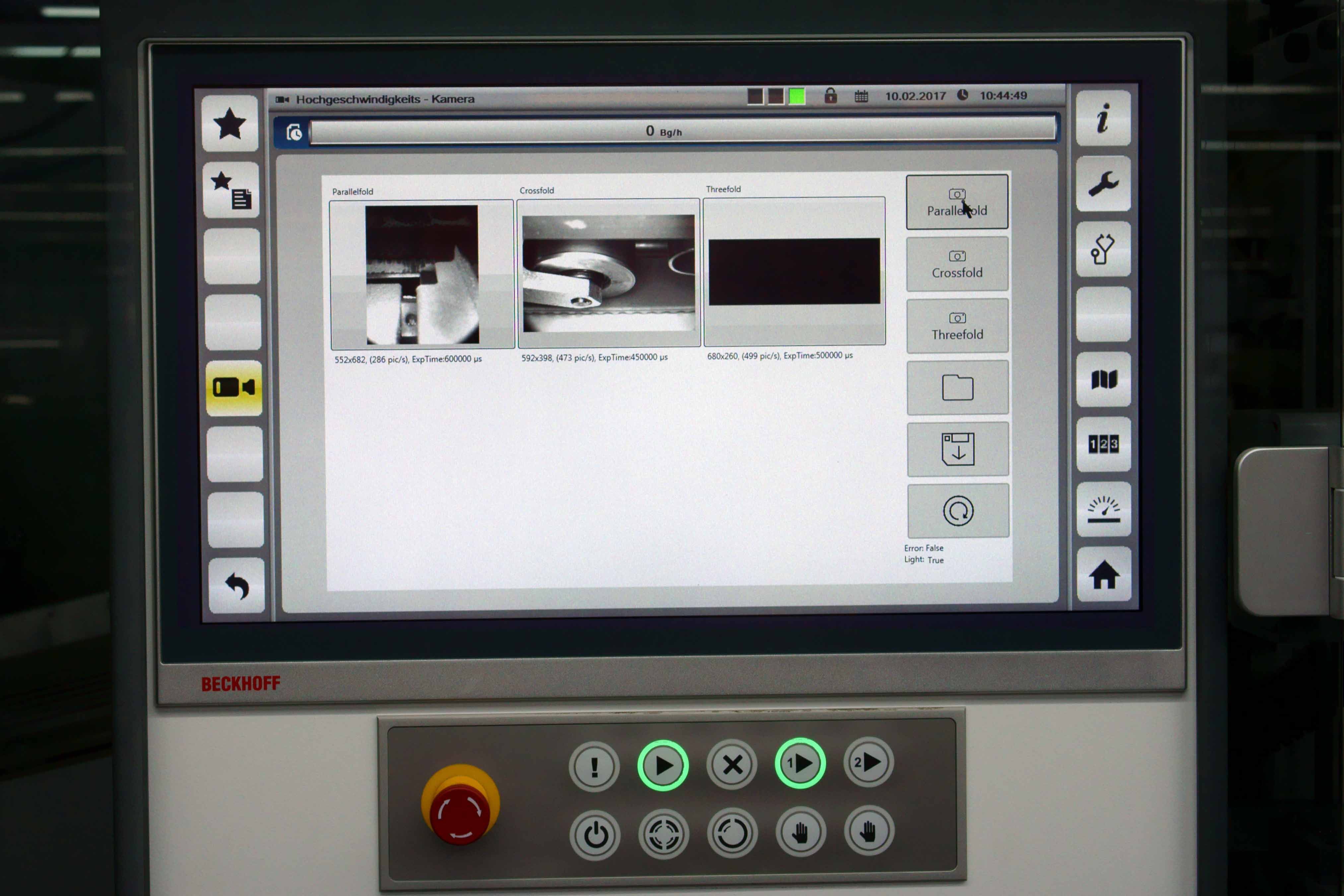
In addition to the personnel-safe monitoring of ongoing production, it was also important to be able to trace any faults that occurred. In terms of software, the live images from several cameras were to be displayed simultaneously as thumbnails in a reduced refresh rate in a user interface. If the operator selects a thumbnail, the image should be enlarged and displayed at the correct frame rate. In addition, the operator should be able to view the last few seconds of the production in slow motion. The camera hardware, in turn, should be able to record at least 100 images per second, have a resolution of at least 640 x 480 pixels and deliver gray-scale images.
Solution
MBO Postpress Solutions GmbH opted for the BVS CA-GX2-0024Z as the gray version due to its suitable resolution, frame rate and image quality, with three cameras each being used to check parallel, cross and triple breaks. The Pregius CMOS sensor IMX174 from Sony installed in the cameras impresses with its reduced dark noise and dynamic range of over 71 dB. As different exposure scenarios will occur in the folding machine, a high dynamic range is of fundamental importance.
How does it work?
The desired minimum resolution of 1280 x 960 pixels with an image depth of 1 byte and a frame rate of 200 frames per second lead to a bandwidth of ≈ 246 MB/sec, with three cameras ≈ 738 MB/sec. Both USB 3.0 and Dual GigE cover the bandwidth of one camera, but Dual GigE has the edge when it comes to the possible cable length of up to 100 meters, which was the decisive factor. Balluff also provided the right support for the optics and lighting. The distance between the camera and the object was approx. 140 mm, while the image size had to be 75 x 60 mm. These specifications could be met with a suitable 6-millimeter lens. For the lighting, a white LED ring light that could be screwed onto the lens provided the appropriate solution.
Benefits
What are the most important features of your application?
- FGPA (Field Programmable Gate Array)
- 256 MB image memory
- Smart Feature: PreTrigger
- Smart Feature: SmartFrameRecall
Products
TheBVS CA-GX2 dual Gigabit Ethernet serieshas a wide range of high-resolution sensors and offers an FPGA and 256 MB image memory. Both are the prerequisite for a range of smart features.
Recommendations
Balluff recommended the use of three separate Dual GigE network cards and three SSD hard disks (write speed approx. 520 MB/sec.) so that the image data could be successfully saved via Dual GigE. With the GigE cables and three cables to control the cameras, the cabling would become complicated. Here too, Balluff offered a simplified solution via a custom-made cable, which made the three control cables superfluous. It goes without saying that the cables can be screwed together and thus contribute to the robustness of the camera system.