

Efficient cleaning of food tanks
Customized camera module enables inline monitoring for adaptive target beam cleaning

Inustry:Food |Customer:Research project in collaboration with Fraunhofer IVV
As part of a research project, Balluff has developed a customized camera solution for an intelligent, autonomously operating tank cleaning system.
The highly integrated and miniaturized sensor technology with the camera as its central element is supplemented by a self-optimizing process control system. This interaction enables the entire tank space to be cleaned as needed. This saves time and resources, which reduces energy consumption and contributes to more sustainable production.
The situation and the challenge
The first step toward efficient, automated cleaning was made possible by a system developed at Fraunhofer IVV. The Adaptive Jet Cleaner (AJC) enables every point in a tank to be targeted precisely using freely programmable cleaning paths. Thanks to preprogrammed cleaning sequences based on the geometry of the tank and the expected degree of contamination, cleaning time has been reduced by up to 25 % compared to conventional methods. However, without continuous monitoring of the degree of cleaning, further optimization potential remained untapped.
The solution
It was only with the integration of a special camera solution developed by Balluff that a highly integrated inline contamination sensor was created in the nozzle head. The new AJCsens is equipped with permanent inline monitoring, which enables adaptive and fully documentable cleaning. Thanks to the minimally invasive integration of the camera sensor technology into the tank cleaning system, no additional implementation effort is required. Practical tests have demonstrated the potential for reducing cleaning time by up to 55 % compared to conventional methods.
The advantages of the solution
- Low power consumption of 1 W
- Image transmission, camera control and power supply via a single coaxial cable connection
- Robust and space-saving solution
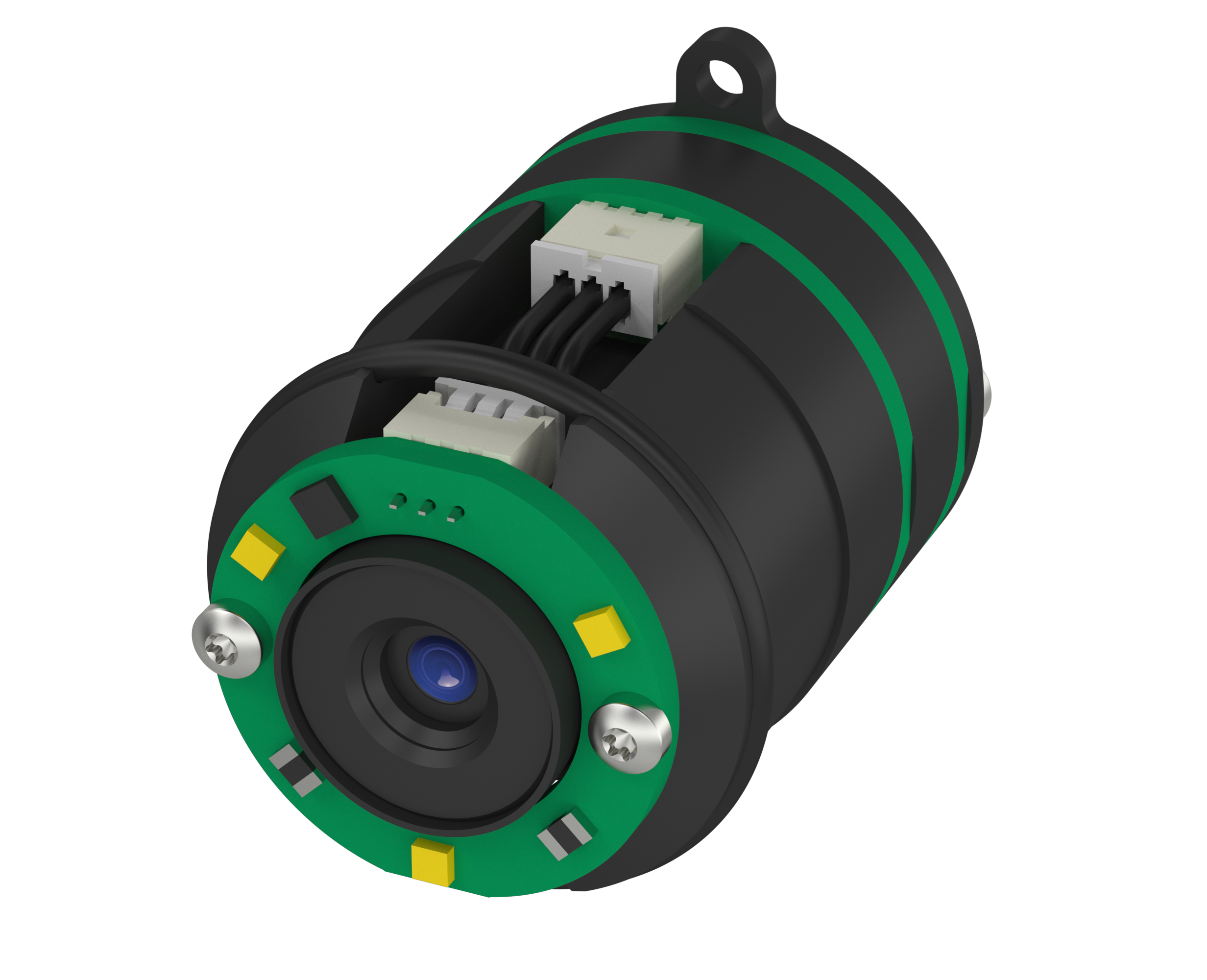
The customized camera solution
Working closely with project partners, Balluff's CDE (Custom Design & Engineering) division developed a customized camera solution that was optimally adapted to the specific requirements of the environment and the limited installation space. Integrating the camera into the existing cleaning head posed special challenges in terms of design - a round cross-section proved to be ideal for achieving a compact and efficient solution.
A central element of image processing is fluorescence detection: residues such as proteins, vitamins, fats, or oils on surfaces are made to fluoresce by targeted excitation from integrated UV LEDs. This method allows even the smallest contaminants to be detected reliably. To ensure high image quality and sharpness at all times, an autofocus lens with a liquid lens and integrated LED lighting were installed in the camera module.
A high-quality global shutter CMOS sensor with 5 MPixel resolution is used as the image sensor. Its high light sensitivity is crucial for reliably detecting fluorescent residues even with weak emissions.
Since most cleaning processes are carried out with hot lye at 80 °C, the entire camera electronics, including optics and lighting, have been sealed and housed in the cleaning head. To make the connection to the outside world as elegant and space-saving as possible, image transmission, camera control, and even power supply are provided via a single coaxial cable connection. Despite the high integration density, the power consumption of the electronics has been kept very low at around 1W. Initial practical tests have already confirmed the desired increase in efficiency, with further stress tests to follow.
In collaboration with Fraunhofer IVV, the camera solution developed was also used to create the independent sensor variant CoControl-LumiHD. This standalone version can be flexibly integrated into a wide variety of applications - not just in tanks. Thanks to its compact, robust, and hygienic design, the sensor is ideal for use in hygiene-critical areas of the food, cosmetics, and pharmaceutical industries. LumiHD thus enables reliable inline detection of contamination - both in stationary installations and in mobile applications, for example on a robot arm.