

Industrial cameras in steel processing
Customized Camera Firmware Simplifies Setup, Reduces Costs of Thermal Cutting Machines
Industry:Steel processingCustomer:Peddinghaus Corporation
Peddinghaus Corporation, based in Gevelsberg, Germany and Bradley, IL, USA, has been a major player in the processing of robust steel for the construction and infrastructure sectors since 1903. Peddinghaus' diverse product portfolio ranges from drilling rigs and band saws to thermal cutting machines. The latter are machines used to cut or mark steel in various profiles (e.g. H, C, angle or L profiles). Cut means not only the cutting of individual sections, but also the cutting of mounting holes or bevel cutting, for example.
Situation
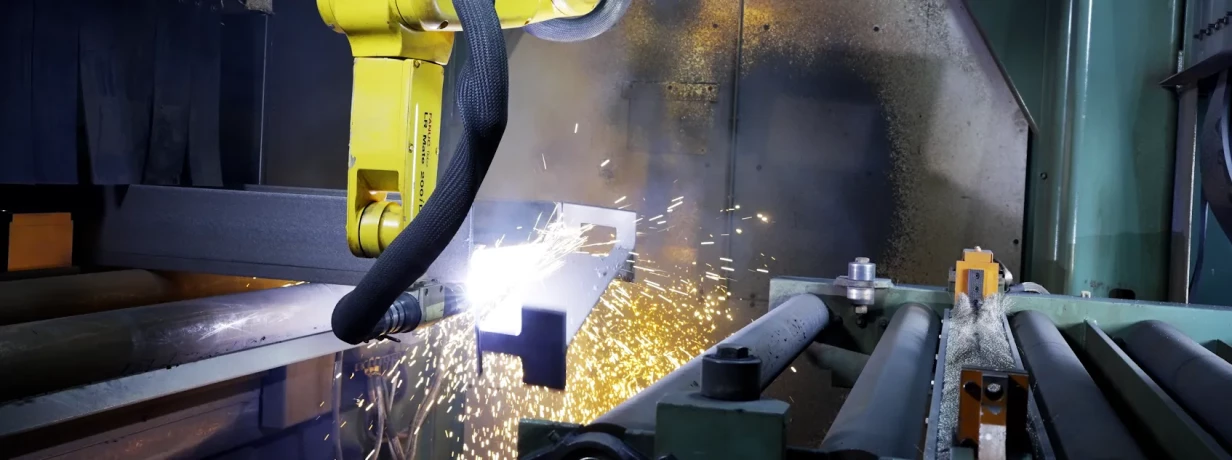
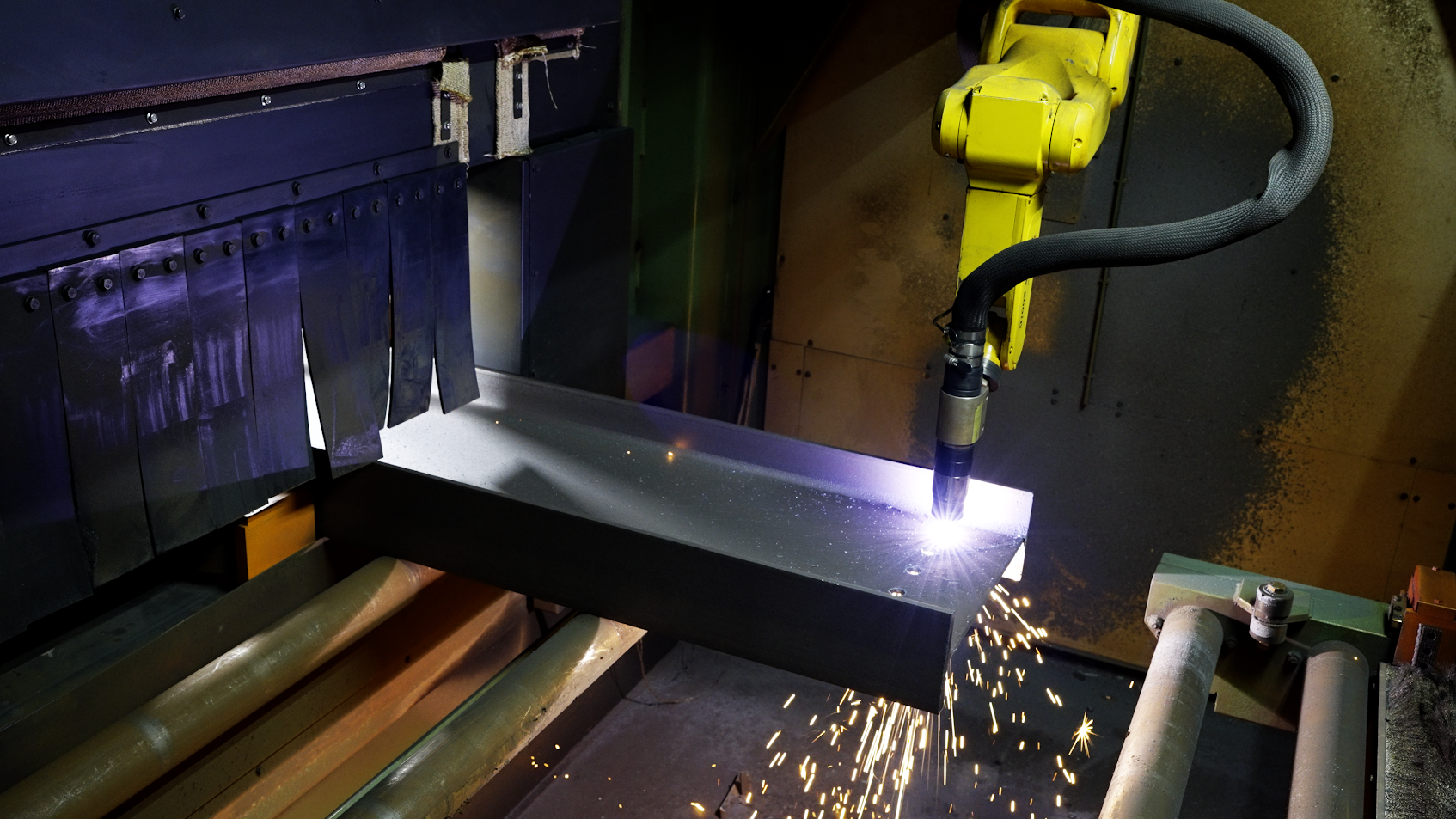
With PeddiBot, Peddinghaus has a product family on the market that enables precise thermal cutting by means of a plasma cutter at the end of a robot arm. Precise means that the distance between the plasma cutter and the steel profile must remain the same in order to achieve a uniform cutting pattern without burrs and therefore without reworking. The data for guiding the robot arm is calculated using a 3D vision system. The steel profile is guided past the vision system, which continuously records a laser beam projected onto the steel and sends the data to a vision server on an industrial PC designed for image processing. A Center of Gravity (COG) algorithm is used to determine the laser line in the image and a homography matrix is applied to convert the 2D pixel coordinates into real 3D measurements. The coordinates for the robot's cutting paths are determined on this basis.
Challenge
With the patented 3D vision scanning process, Peddinghaus already has a unique selling point in the market, which is considerably more cost-effective than its competitors, as the consistent cutting quality reduces process times and eliminates the need for a separate stage to measure the steel parts. Nevertheless, Peddinghaus is constantly striving to improve and offer customers new benefits. For this reason, the PeddiBot was also examined and consideration was given to where there is still potential for improvement. The focus was on the 3D vision system. As sensors from Balluff were already in use with pressure and position sensors, Peddinghaus wanted to find out more about the possibilities in the vision sector and asked Balluff.
The selection of standard industrial cameras at Balluff is immense, so that a better replacement was found in terms of resolution, interface and frame rate with the BVS CA-GX0, a GigE Vision camera family with robust industrial connectors and Power over Ethernet. But simply replacing a 3D vision camera with two industrial cameras does not bring any customer benefits. This is where Balluff's Custom Design & Engineering (CDE) division came into play, offering customers special customized solutions for camera and sensor components.
Solution
As the BVS CA-GX0 industrial cameras from Balluff have an FPGA and can be equipped with their own algorithms, Peddinghaus suggested that the center of gravity (COG) calculation should be performed directly in the camera. Balluff confirmed the feasibility, adapted the camera's firmware and created a customer-specific solution from a standard camera. The camera drivers were also adapted so that a customer-specific and GenICam standard-compliant feature control was made available to Peddinghaus in the Impact Acquire API from Balluff. The control enables Peddinghaus to switch the center of gravity (COG) calculation on and off via API or to optimize the center of gravity (COG) data and thus the detection of the laser profile, e.g. by threshold value or specification of the minimum and maximum width of the laser profile.
How does it work?
As seemingly small as the idea may appear, the impact on the overall system was huge. Firstly, the industrial camera reduces the cost of the overall system, as it firstly replaces the more expensive 3D vision camera, secondly makes the industrial PC required to process the data from the 3D vision camera obsolete and thirdly significantly simplifies the setup of the image processing system. Secondly, the extensive range of image sensors at Balluff gives Peddinghaus greater flexibility in terms of working distances. The previous 3D vision cameras were limited in resolution and unnecessarily restricted the working range of the thermal cutting machines.
Benefits
Thanks to the firmware adaptation of the Balluff industrial camera, the new generation of PeddiBot, the PeddiBot-1250 ST, will not only use one industrial camera from Balluff, but five to see the top and sides of each steel beam up to a width of 1250 mm. A separate industrial PC for image processing is still not required and the five industrial cameras are still considerably cheaper than a 3D vision camera. Peddinghaus Corporation found the collaboration with Balluff pleasant and motivating throughout the entire development process of the customer-specific adaptation, as a contact person was always available to find a solution, even in the event of supposed obstacles. This is one of the many strengths of "Custom Design & Engineering (CDE)".
- FGPA (Field Programmable Gate Array)
- 256 MB image memory
Products
A look at the Balluff portfolio revealed the BVS CA-GX0 industrial cameras as a solution. - flexible, wide selection, and ideal for customization.