

Simplifying Packaging Machine Design
How standardization reduces complexity without compromising performance
Reading Time: minutes
TL;DR

Packaging OEMs can reduce complexity by standardizing machine architectures instead of creating unique solutions for every project.
Reusable machine platforms can reduce engineering and commissioning effort while maintaining the flexibility required for different applications.
IO-Link provides a standardized field-level communication architecture that can simplify device integration, configuration, and diagnostics.
RFID and condition monitoring can support automated identification, better machine visibility, and more efficient maintenance.
The goal is not to remove functionality, but to standardize what can be reused and differentiate where it creates customer value
Packaging OEMs face a difficult reality. Customers expect more flexibility, faster changeovers, better traceability, better diagnostics, and higher machine availability than ever before. At the same time, engineering resources are limited, project deadlines are tighter, and pressure on machine costs continues to increase. The challenge is no longer simply delivering more functionality. The challenge is delivering it efficiently.
Successful machine builders are increasingly focusing on reducing unnecessary complexity, standardizing machine architectures, and creating scalable platforms that can be reused across multiple projects.
Roberto Caffarelli, Head of Packaging EMEA at Balluff
Why complexity is increasing
Modern packaging machines must support:
more product variants and SKUs,
shorter production runs,
more frequent format changes,
new packaging materials,
higher traceability requirements,
greater expectations for uptime and diagnostics.
Every new requirement adds potential complexity. If each customer request leads to a unique hardware configuration, custom engineering, or a new machine variant, costs quickly accumulate throughout the machine lifecycle.
The most successful OEMs are not necessarily those that build the most customized machines. They are the ones that create flexible machine platforms capable of accommodating change without requiring extensive redesign.
Looking beyond component costs
When discussing machine costs, many design decisions are evaluated primarily based on component prices. However, machine performance and profitability are influenced by much more than the bill of materials.
A machine architecture that is easy to engineer, commission, operate, and maintain often delivers greater long-term value than one optimized solely for initial hardware cost.
For packaging OEMs, reducing complexity often means reducing the number of technologies, interfaces, and processes that must be managed throughout the machine lifecycle.
Standardization as a competitive advantage
Standardization does not mean sacrificing flexibility. In many cases, it enables greater flexibility by creating a common foundation that can be adapted to different applications.
Technologies such as IO-Link help OEMs establish a consistent field-level communication architecture, simplifying integration and improving access to device data. The right combination of standard and IO-Link sensors provides the necessary operational flexibility while reducing variants and streamlining the BOM. RFID-based identification solutions help automate verification processes and support more reliable machine operation. Condition monitoring technologies provide additional visibility into machine health, helping operators make more informed maintenance decisions.
When these technologies are integrated into a standardized machine platform, OEMs can reduce engineering effort while improving machine usability and serviceability.
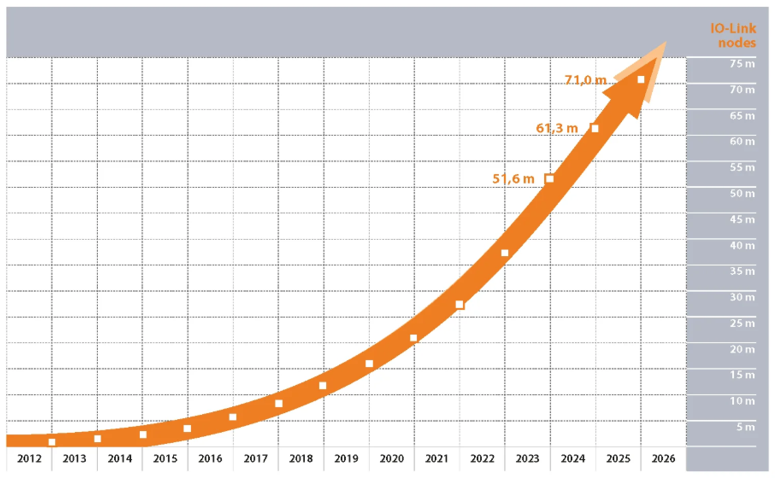 Growth of IO-Link nodes worldwide demonstrates the increasing adoption of standardized communication technologies in industrial automation. As these standards gain broader adoption, packaging OEMs can benefit from improved interoperability, reduced engineering effort, and greater platform scalability.
The value of repeatable machine platforms
A repeatable machine platform allows OEMs to reuse proven concepts instead of starting from scratch for every project.
The benefits include:
Reduced engineering effort
Faster commissioning
More consistent machine behavior
Easier maintenance and troubleshooting
Lower training requirements
Greater scalability across product families
Rather than solving the same problems repeatedly, engineering teams can focus on improvements that create real customer value.
Simplifying without compromising performance
Reducing complexity is not about removing functionality. It is about eliminating unnecessary variation and creating systems that are easier to build, operate, and maintain.
As packaging applications continue to evolve, OEMs are expected to deliver greater flexibility and performance while keeping machines cost-competitive and lifecycle costs under control. Achieving this balance increasingly depends on standardization, reuse, and scalable machine design.
The key principle is simple:
Standardize what scales. Differentiate only where it creates customer value.
Watch the webinar
Want to explore the concepts discussed in this article in more detail?
Watch the full webinar
FAQ
How can packaging machine builders reduce engineering complexity?
OEMs can reduce complexity by standardizing machine architectures, using common communication technologies, reusing validated engineering solutions, and minimizing project-specific customization.
Can packaging OEMs reduce costs without sacrificing machine performance?
Yes. Cost reduction does not have to come at the expense of machine performance. By standardizing machine architectures, reusing proven engineering concepts, and improving diagnostics and maintenance processes, OEMs can reduce engineering and lifecycle costs while maintaining the flexibility, reliability, and performance their customers expect.
Why is machine standardization important for packaging OEMs?
Every unique design decision can add complexity across engineering, commissioning, maintenance, and service. Standardization creates a common foundation that reduces this variation, allowing OEMs to reuse proven solutions, simplify commissioning and troubleshooting, and scale machine platforms more efficiently across different projects and product families.
What technologies help simplify packaging machine design?
Technologies that standardize communication, automate machine processes, and provide better access to device and machine data can significantly simplify packaging machine design. For example, IO-Link creates a consistent communication layer between sensors, actuators, and the control system, making devices easier to integrate, configure, and replace. RFID can automate identification and verification tasks, while condition monitoring provides insights into machine health without adding complex standalone diagnostic systems.
How does reusable engineering improve machine development?
Reusable engineering gives machine builders a proven foundation for new projects instead of requiring them to redesign similar functions each time. Standardized hardware concepts, communication architectures, and validated configurations can be adapted to different machine variants or customer requirements. This shortens development and commissioning time, reduces engineering risk, and allows teams to focus their resources on features that create additional customer value.
How can machine builders reduce total cost of ownership?
Machine builders can reduce total cost of ownership by considering costs beyond the initial hardware investment. Standardized architectures can reduce engineering and commissioning effort, while better diagnostics and condition monitoring can simplify troubleshooting and help prevent unplanned downtime. Reducing the number of variants and interfaces also makes spare parts management, maintenance, and employee training easier throughout the machine lifecycle.
Comment
Popular posts
The industrial revolution - from the steam engine to Industry 4.0
Sensors for Detecting Transparent Media
IO-Link vs. IO-Link Wireless: Enhancing Flexibility and Efficiency in Automation
Advantages of inductive proximity sensors in industry
Contact form
Do you have any questions or suggestions? We are at your disposal.
Balluff ApS
-
Niels Jernes Vej 10
9220 Aalborg Øst