

When Color, Surface, and Transparency Become a Challenge
Why Ultrasonic Sensors Deserve a Closer Look
Reading Time: minutes
Photoelectric sensors are among the most widely used sensing technologies in industrial automation. They provide fast, reliable detection and are suitable for a broad range of applications.
However, some applications introduce challenges that can affect optical sensing performance. Changes in color, reflectivity, contamination, or transparency may require additional adjustments and can make reliable detection more difficult.
This is where ultrasonic sensors offer a different approach.
Why Some Targets Are Difficult to Detect
Photoelectric sensors rely on light to detect objects. Depending on the sensing principle and application, several target characteristics can influence detection performance.
Common challenges include:
Dark versus light-colored objects
Matte versus reflective surfaces
Oil, grease, or contamination on the target
Transparent materials such as glass or clear plastics
For maintenance teams and automation engineers, these conditions can lead to:
Repeated sensor adjustments
False triggering
Missed detections
Production interruptions
The Challenge of Transparent Materials
Transparent objects present a unique challenge because light can pass through the target rather than generating the expected signal.
Examples include:
Automotive windshields
Headlamp lenses
Clear plastic containers
Glass panels
In these applications, engineers often spend significant time optimizing sensor selection, mounting positions, reflector alignment, and background conditions to achieve reliable performance.
A Different Sensing Principle
Ultrasonic sensors operate differently.
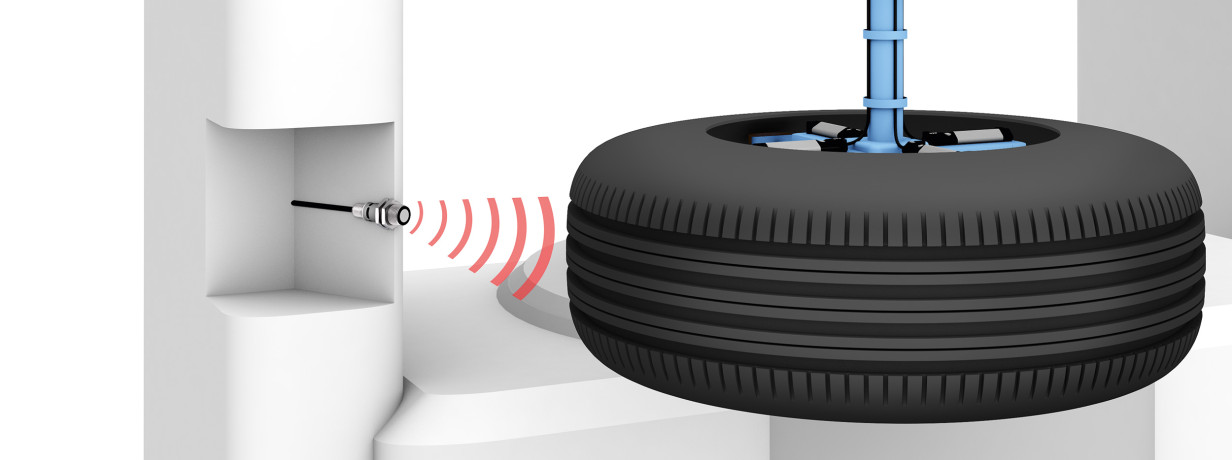
Rather than using light, they emit sound waves and measure the time required for the echo to return from the target.
Because detection is based on sound, characteristics such as color and optical reflectivity become significantly less important.
An ultrasonic sensor can detect:
White or black targets
Matte or shiny surfaces
Clean or contaminated parts
Opaque or transparent materials
This makes ultrasonic technology especially valuable when product characteristics change during production.
Why Ultrasonic Sensors Work Well with Transparent Objects
Consider a windshield moving through an automotive assembly line.
A photoelectric sensor must successfully interact with the optical properties of the glass. Depending on the application, this may require careful system design and sensor selection.
An ultrasonic sensor approaches the challenge differently.
The question is no longer:
"Can I see the object?"
Instead, the sensor asks:
"Did my sound wave encounter an object, and how far away is it?"
This fundamentally different approach often simplifies detection in transparent-material applications.
Choosing the Right Technology
Ultrasonic sensors are not intended to replace photoelectric sensors.
Photoelectric technology remains the preferred solution for many applications requiring:
High-speed detection
Small target recognition
Precise positioning
Long sensing ranges
The real objective is selecting the sensing principle that best matches the application.
Applications involving changing colors, reflective surfaces, contamination, or transparent materials may benefit from evaluating ultrasonic technology as an alternative.
Conclusion
Successful sensor selection starts with understanding the application, not with choosing a familiar technology.
When color, reflectivity, transparency, or surface conditions create detection challenges, ultrasonic sensing provides a powerful alternative that operates independently of optical characteristics.
Sometimes the best solution is not finding a way to make a photoelectric sensor work harder.
Sometimes the better solution is to sense the target differently.
See beyond the surface. Consider ultrasonic sensing.
Keywords
- IO-Link
- Efficient production
- Sensor technology
- Robotik
- Industrielle Automatisierung
Author
Jorge Castillo
Jorge Castillo has more than 18 years of experience in industrial automation and leads Balluff’s Automotive strategy across the Americas. Having worked throughout Mexico, Argentina, Brazil, and the United States, he collaborates with OEMs, Tier 1 suppliers, and machine builders to accelerate digital transformation, improve manufacturing efficiency, and drive innovation across the automotive industry.
0 Contributions