

Why Process Data and Parameters Are Not the Same Thing
Understanding what an IO-Link device is reporting and what it is configured to do
Reading Time: minutes
A Common Point of Confusion
A device is replaced during maintenance, upgraded during a retrofit, or installed as part of a new machine build. Communication starts normally. Data is flowing. Yet the machine does not behave the way everyone expected.
In situations like this, people often focus first on the process data because it is visible and changing. Sometimes the real answer is found somewhere else, in the parameters that define how the device operates.
Process data and parameters come from the same IO-Link device and use the same connection, but they are not the same thing. Understanding the difference can make commissioning, troubleshooting, and device replacement much easier.
The Data That Changes
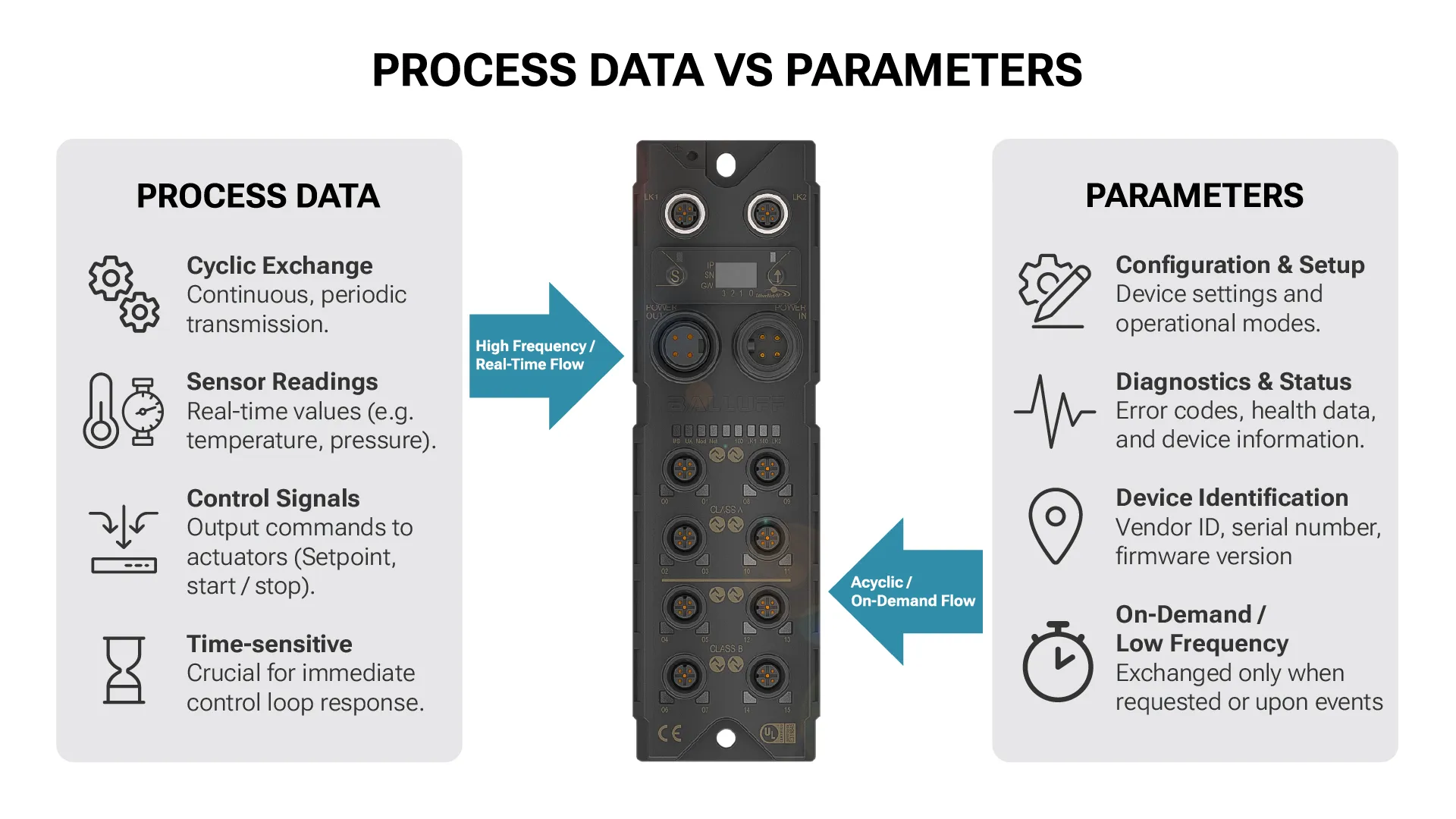
Process data is the information a device exchanges continuously while it operates. For a sensor, this might be a measured position, distance, temperature, pressure, or status value. For an actuator, it may include commands or operating states.
Think of process data as the information needed to run the machine right now. It changes because the application changes.
Process data answers a simple question: What is happening right now?
The Settings Behind the Behavior
Parameters serve a different purpose. They define how the device should operate. Examples include switching thresholds, measurement ranges, filtering options, operating modes, and response behavior.
Unlike process data, parameters usually remain unchanged during normal operation. They are commonly configured during commissioning and revisited when the application changes.
Parameters answer a different question: How should this device behave?
 Why the Difference Matters
A sensor may report a value that appears correct while the machine still responds differently than expected. The process data may be telling you what the sensor sees. The parameters may be explaining why the device, and therefore the machine, reacts the way it does.
Process data shows the current result. Parameters often explain the current behavior. Looking at one without the other can leave an incomplete picture.
The Real Value
One of the strengths of IO-Link is access to both process data and parameters through the same connection. Technicians and engineers can see not only what a device is reporting, but also how it has been configured.
When that distinction is clear, troubleshooting becomes more focused, commissioning becomes more predictable, and replacement devices are easier to put back into service.
Instead of asking only, “What is the device reporting?” it becomes natural to also ask, “What is the device configured to do?”
And when a system that worked yesterday no longer behaves the same way today, a third question becomes equally important:
“What changed?”
Those questions often lead to the real answer.
Closing Thought
Process data and parameters work together, but they solve different problems. Process data describes what is happening. Parameters define how the device behaves. Understanding the difference is one of the simplest ways to reduce confusion and gain more value from an IO-Link system.
Keywords
- Industrial network technology
- IO-Link
- The basics of automation
- Industrielle Automatisierung
- Intelligente Sensorik
- Connectivity
Author

Dan Thompson
Dan Thompson is a Senior Technical Trainer at Balluff Inc., where he supports technicians and engineers in understanding and applying automation technologies in the field. His work focuses on IO-Link, system behavior, and clear, practical troubleshooting.
0 Contributions