

Detecting liquid media and bubbles using optical sensors
Discover liquid media detection in life sciences and the benefits of precise sensing, evaluating liquid media, detecting multiple events, and ensuring high sensor reliability
Reading Time: minutes
In my line of work in Life Sciences, we often deal with liquid media and bubble detection evaluation through a vessel or a tube. This can be done by using the absorption principle or the refraction principle with through-beam-configured optical sensors. These are commonly embedded in medical devices or lab instruments.
This configuration provides strong benefits:
Precise sensing
Ability to evaluate liquid media
Detect multiple events
High reliability
How does liquid detection work?
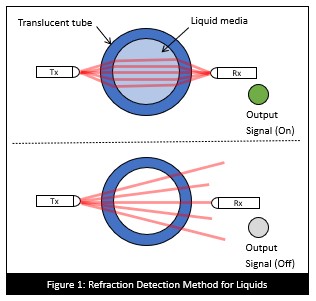
The refraction principle is based on the media’s refraction index. It uses an emitted light source (Tx) that is angled to limit the light falling on the receiver (Rx, Figure 1). When the light passes through a liquid, refraction causes the light to focus on the receiver as a beam (known as a “beam-make” configuration). All liquids and common vessel materials (silicon, plastic, glass, etc.) have a known refraction index. These sensors will detect those refraction differences and output a signal.
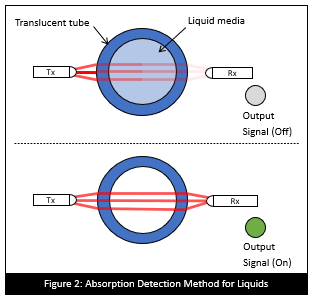
 The absorption principle is preferred when a media’s absorption index is high. First, a beam is established through a vessel or tube (Figure 2). Light sources in the 1500nm range work best for aqueous-based media such as water. As a high absorption index liquid enters the tube, it will block the light (known as a beam-break configuration). The sensor detects this loss of light.
 Discrete on-off signals are easily used by a control system. However, by using the actual light value information (commonly analog), more data can be extracted. This is becoming more popular now and can be done with either sensing principle. By using this light-value information, you can differentiate between types of media, measure concentrations, identify multiple objects (e.g., filter in an IV and the media) and much more.
There is a lot to know about through-beam sensors, so please leave a comment below if you have questions on how you can benefit from this technology.
Keywords
- Sensor technology
Author

Tom Rosenberg
1 Contributions