

Flow sensors for reliable process monitoring
Monitor the flow of process media
Balluff flow sensors reliably monitor liquid media in cooling, lubrication and other fluid systems. Continuous flow monitoring of water, coolant, lubricants or oil helps protect critical machinery and equipment and reduce unplanned downtime. Via IO-Link, our flow sensors and flow switches provide process, status and diagnostic data for transparent process monitoring and efficient maintenance.
Our portfolio of flow sensors for different requirements
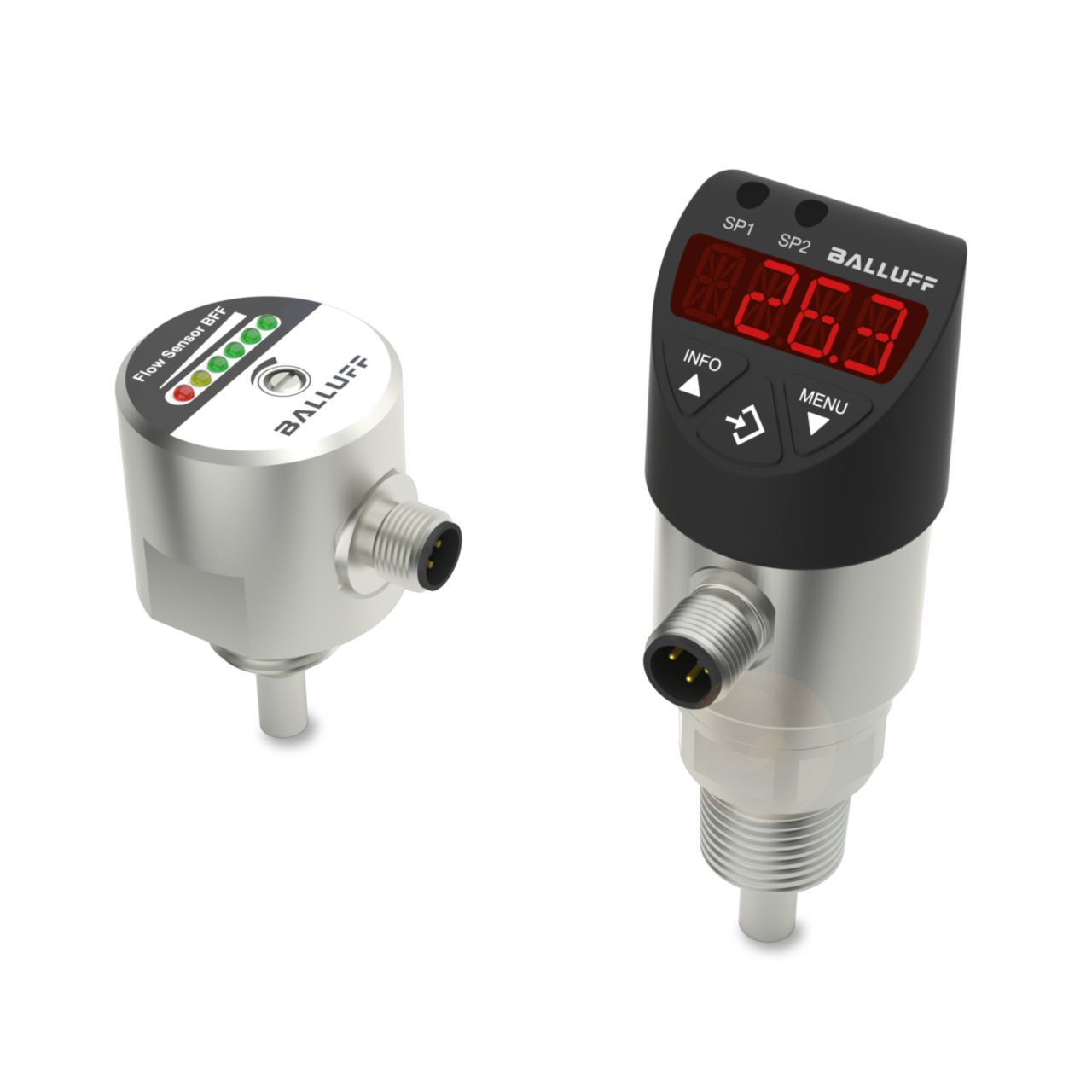
Process reliability through dependable flow monitoring
Flow measurement and flow monitoring are important aspects of industrial process sensing. A stable media flow ensures, for example, that machine tools receive a sufficient supply of coolant, lubrication points operate reliably and pumps do not run dry.
Thanks to different measuring ranges and process connections, our flow sensors can be flexibly integrated into various applications. The diagnostic data provided via IO-Link also support condition monitoring and predictive maintenance.

Reliably monitor flow. Efficiently safeguard processes.
Detect process deviations at an early stage

Increase machine availability

Use measurement and diagnostic data with IO-Link

Flexible integration and easy parameterization

Typical applications of flow sensors for monitoring process media
Whether cooling water, metalworking fluids, lubricants or oil: Reliable media flow monitoring helps keep supply processes stable and protect machinery and equipment. Precise measurement of the flow rate is not always required. It is often crucial to reliably determine whether a medium is flowing and a defined limit is being maintained. Thermal flow sensors and flow switches are therefore suitable for various monitoring tasks in industrial fluid circuits. Depending on the installation position, a change in flow may indicate pump malfunctions, clogged filters or leaks, for example.
Monitoring the coolant supply in machine tools
Task: Functional monitoring of the cooling and lubrication system
A reliable supply of coolants and lubricants is crucial in metalworking. Flow switches monitor the coolant flow and detect when the required media flow is no longer ensured. This enables malfunctions in the cooling and lubrication system to be detected at an early stage while reducing friction, wear and thermal loads.
Protecting pumps and media supply systems
Task: Detecting insufficient or interrupted media flow
Pumps depend on a reliable media supply. Insufficient or completely interrupted flow may indicate a critical condition in the fluid circuit. Flow monitoring makes it possible to detect such deviations at an early stage and trigger appropriate machine responses. This protects pumps and downstream system components and reduces unplanned downtime.
Identifying maintenance requirements in fluid circuits at an early stage
Task: Condition monitoring of fluid circuits
Media flow can provide important information about the condition of a fluid circuit. If the flow behavior changes relative to the defined operating state, maintenance or inspection measures can be initiated as needed. In conjunction with available status and diagnostic data, flow monitoring can thus be incorporated into the condition monitoring of machinery and equipment. This supports condition monitoring, targeted maintenance and the prevention of unplanned downtime.
Do you need support or have specific requirements?
We will be happy to help you select the right sensors.Flow measurement or flow monitoring?
Flow meters, flow monitors or flow switches: What is the difference?
These terms are sometimes used interchangeably in industrial environments. Flow sensor is the umbrella term for sensors used to measure or monitor media flow. Depending on the measuring principle and sensor design, the focus may be on measuring a flow value or monitoring a defined flow state.
The measuring task should therefore be the decisive factor when making a selection: Is a quantitative measured value required, or is the main objective to monitor a critical minimum value or limit state?
|
Measurement Task |
What is measured or monitored? |
Typical device type |
Application |
|
Flow Measurement |
Quantitative flow value, e.g., volumetric or mass flow |
Flow meter |
Volume measurement, process control, consumption monitoring |
|
Flow Monitoring |
Flow condition or compliance with a defined limit value |
Flow monitor |
Coolant monitoring, pump protection, monitoring of fluid circuits |
Selecting the right flow sensor
In addition to the measuring task, the medium, process conditions and installation situation are crucial when selecting the appropriate sensor. These six criteria help with the technical selection:

PROCESS MEDIUM - Medium and material compatibility
Which medium is being monitored? Water, cooling water, metalworking fluid and oil place different requirements on the sensor and wetted materials. Resistance to the medium used must be taken into account during selection.

MEASURING TASK - Measured value or limit value
What needs to be measured or monitored? The decisive factor is whether a quantitative flow value is required or a defined flow state or limit value needs to be monitored.

OPERATING RANGE - Select the appropriate flow range
Which operating range is required? The sensor's operating or monitoring range must match the medium and flow conditions of the application. The expected range and required switching point are particularly relevant.

PROCESS CONDITIONS - Consider operating limits
Under what conditions will the sensor be used? Media temperature, process pressure, ambient temperature and material compatibility must remain within the specified operating limits.

INSTALLATION SITUATION - Check mechanical integration
How will the sensor be installed? The process connection, insertion length, installation position and available installation space determine the appropriate design and must be compatible with the existing system.

OUTPUT & COMMUNICATION - Select the appropriate signal output
Depending on the automation task, switching signals or communication data are required. IO-Link can additionally provide process, status and diagnostic data for system monitoring and condition monitoring.
Flow sensors as part of the Balluff process sensor portfolio
The Balluff fluid sensor portfolio includes sensor solutions for the key measured variables of flow, pressure, temperature and level. In addition to flow sensors and flow switches, Balluff offers pressure sensors and pressure transmitters, temperature sensors and various solutions for level measurement. This allows different process variables to be measured and monitored using coordinated sensor solutions from Balluff.
Frequently asked questions about flow sensors and flow monitoring
-
What is the difference between flow rate and flow velocity?
Flow generally describes the movement of a medium. Flow velocity indicates how quickly the medium moves, for example in cm/s. Volumetric flow rate, on the other hand, describes the volume of liquid flowing through a defined cross-section within a specified period, for example in l/min. The two variables are related but are not equivalent.
-
What is the difference between a flow switch and a flow meter?
Flow switches and flow meters can be based on the same physical measuring principle but perform different tasks. Taking thermal flow sensors as an example: Both use the heat dissipation caused by the flow of a medium as their measuring principle. The key difference lies not in the thermal measuring principle but in the function and the measurement information provided.
Thermal flow switches are primarily used to monitor flow states or defined limit values. For example, they detect whether the required minimum flow has been reached or fallen below and provide a corresponding switching signal for process monitoring.
Thermal flow meters, on the other hand, are used for quantitative flow measurement and provide a specific measured value, such as the volumetric flow rate in l/min or the mass flow rate in kg/h.
-
How do the properties of the medium affect flow monitoring?
The properties of the process medium affect flow detection. Density, viscosity, temperature and thermal properties can influence measurement behavior. With thermal sensors, heat transfer between the sensor element and the medium is particularly relevant. The sensor's operating ranges and conditions specified for the respective medium must therefore be observed.
-
How is the correct switching point of a flow switch determined?
The switching point should be selected so that a critical deviation from the required media flow is detected at an early stage without normal process-related fluctuations causing unnecessary switching operations. The minimum flow required for the application, the normal operating range and possible process fluctuations are decisive factors. The setting is made in accordance with the technical capabilities and specifications of the respective flow switch.
-
Are flow sensors maintenance-free?
This depends on the sensor type, measuring principle and application. Thermal flow sensors do not require mechanically moving parts to detect flow, resulting in low mechanical wear. However, deposits or contamination on the sensor element can affect detection. Depending on the medium and operating conditions, the sensor should therefore be inspected regularly and cleaned as required.
-
What must be considered when installing a flow sensor or flow switch?
When installing the sensor, particular attention must be paid to the process connection, installation orientation and position, flow direction and installation situation in the pipe. Depending on the sensor, defined insertion depths or inlet and outlet conditions may also be required. The installation instructions and technical specifications for the respective sensor version should therefore be observed to ensure reliable operation.
-
What benefits does IO-Link offer for flow monitoring?
In addition to transmitting process data, IO-Link provides access to status, diagnostic and parameter data, provided these are made available by the respective sensor version. This allows sensor parameters to be integrated into the automation concept and additional condition information to be used for diagnostics and Condition Monitoring. This simplifies commissioning, system monitoring and maintenance.