

Level Measurement Made Easy: How to Pick the Right Sensor for Your Application
A practical guide to ultrasonic, capacitive, radar, pressure, and magnetostrictive sensors and how to match each to real-world process conditions.
Reading Time: minutes
Manufacturers are under growing pressure to increase visibility into their processes and capture more real-time data. Traditional methods like sight glasses, mechanical floats, dipsticks, and tape measures (“yo-yos”) do not support remote monitoring, trending, or predictive maintenance. They also create safety and environmental risks when operators need to climb tanks or when overflows lead to costly cleanup.
In automotive and general industrial manufacturing, the consequences of poor level monitoring are significant. Low oil levels can damage equipment. Loss of coolant can shut down machining lines. Incorrect chemical levels can impact wash systems or coating processes. Overflowing scrap or dust bins can create a mess on the factory floor costing time and resources to clean up. These are not minor issues, they are expensive downtime events that drain resources.
Modern level technologies enable continuous monitoring, integration into PLC and SCADA systems, and immediate alerting. At Balluff, the core technologies used in industrial level applications include ultrasonic, capacitive, radar, pressure, and magnetostrictive linear position sensors. Each has strengths. The key is matching the technology to the process conditions.
Ultrasonic Level Sensors
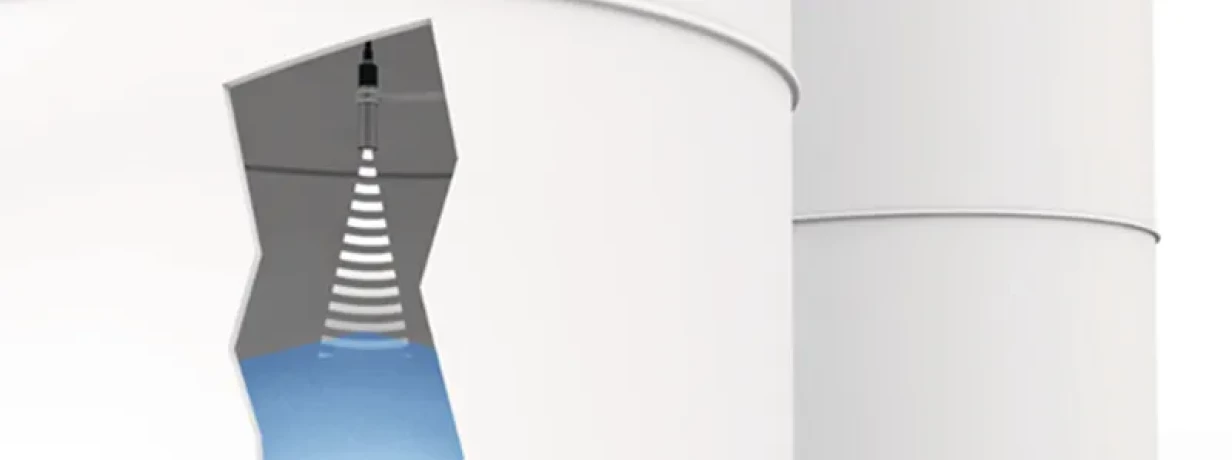
Ultrasonic sensors use time-of-flight measurement. The sensor emits a sound wave and calculates the distance based on the time it takes for the signal to return. Balluff ultrasonic sensors offer measurement ranges up to 8 meters, ideal for short to medium distance applications.
Important considerations:
Dead zone: Every ultrasonic sensor has a blind area below the sensing face where measurement cannot occur.
Beam angle: Wider beam angles can create false reflections in narrow tanks or tanks with internal structures.
Environmental sensitivity: Temperature fluctuations, dust, foam, and heavy vapors can influence performance.
Where ultrasonic works well:
Tank farms
Process water vessels
Open tanks with clear mounting locations
Ultrasonic remains a cost-effective and reliable choice when the measurement path is unobstructed and environmental conditions are moderate.
Capacitive Level Sensors
Capacitive sensors detect changes in dielectric properties between the sensor and the target media. They can provide point-level detection or continuous level measurement.
Balluff offers several form factors, including tape-style continuous level sensors (such as BCW0004) that mount externally on plastic tanks, as well as compact point-level sensors like BCS00U6 for high and low level detection.
What makes capacitive sensors unique:
Can measure through non-conductive materials like plastic and fiberglass
Allows non-contact, external mounting
Suitable for both point and continuous level measurement
Can detect or ignore foam depending on setup
Performs well in sticky or dusty applications
Designed to ignore buildup on the sensing face
Best-fit applications:
Plastic or fiberglass tanks
Adhesive or chemical containers with sticky or viscous media
Applications with foam present
Dusty bulk material bins needing point-level detection
Capacitive level sensors are commonly used with adhesive or sticky media where build up can occur, foam detection is required or in plastic tanks or vessels
Radar Level Sensors
Radar sensors also use time-of-flight measurement but rely on electromagnetic waves instead of sound. Balluff’s 122 GHz radar technology offers a narrow beam angle and a compact antenna design, making installation easier in confined spaces.
Why frequency matters: Higher frequencies allow:
Narrower beam angles
Improved performance in tight or cluttered tanks
Reduced interference from tank walls or internal components
Balluff radar sensors can measure up to 15 meters, supporting long-range applications.
Key advantages:
Unaffected by temperature extremes
Not influenced by dust, buildup, or splashing
Can measure through non-conductive materials
Allows external mounting to avoid corrosion or contact with the media
Highly reliable in harsh conditions
Typical applications:
Tank farms with vapors or buildup
Dust or scrap bins
Hoppers
Process water tanks
Sumps
Silos and bulk material storage
Radar is often the best option when dust, splashing, or buildup are present and stability is critical.
Pressure-Based Level Measurement
Pressure sensors measure hydrostatic pressure at the bottom of a tank. The greater the fluid height, the higher the pressure. This method is widely used in industrial environments.
Advantages:
Can be installed at the bottom of the tank
Ideal when top access is not available
Simple and proven measurement method
Considerations:
Contact-based measurement
Cannot measure below the mounting point
Potential sensor drift over time
Diaphragms can wear in abrasive or aggressive media
Changes in media density affect accuracy
Metal diaphragms provide durability in many industrial fluids, while ceramic elements offer better resistance to abrasion and chemical attack.
Common uses include coolant sumps, hydraulic oil tanks, and wash systems where bottom mounting is more practical.
Magnetostrictive Linear Position Sensors (Float-Based)
Magnetostrictive sensors detect the position of a magnetic float along a rod to provide precise, continuous level feedback.
Strengths:
High accuracy
True continuous measurement
Excellent long-term stability
Limitations:
Contact-based technology
Floats can stick in viscous or sticky media
Abrasive materials can cause wear
Float density must be lower than the media
Chemical compatibility must be evaluated
These sensors are typically used in hydraulic reservoirs, lube oil systems, and other clean fluid tanks that require precise monitoring.
Choosing the Right Technology
There is no universal solution. The correct level technology depends on:
Tank material
Media properties
Presence of dust, foam, or buildup
Required measurement range
Mounting constraints
Maintenance expectations
For plastic vessels with sticky media, capacitive sensors provide flexibility and resistance to buildup. Ultrasonic sensors are a great fit for an economical, non-contact technology that can be used in straightforward, clean applications. For long range or harsh conditions with dust and splashing, high frequency 122 GHz radar delivers stable performance. When top mounting is not possible, pressure sensors offer a practical alternative. For high precision clean fluid measurement, magnetostrictive technology remains a strong option.
Modern manufacturing demands visibility, safety, and reliability. Moving from manual checks to continuous electronic measurement reduces risk, improves uptime, and provides the data needed for smarter process control.
Selecting the right technology comes down to understanding the application demands, mounting requirements and process conditions.
Keywords
- IO-Link
- Efficient production
- Industry 4.0
- Safety
- Sensor technology
- Basics of automation
- Industrial automation
- Technology trends
- Asset tracking
- Smart sensor technology
- Internet of Things
- Condition monitoring
- Distance measurement
Author

Sean Hogan
As an Automotive Key Account Manager at Balluff, I’m supporting Tier 1 powertrain customers on sensing and automation solutions. Previously, I worked in the process industry with a strong focus on level measurement technologies and applications.
3 Contributions