

Understanding “true analog” resolution
Decoding true analog resolution: understanding the factors that define precision
Reading Time: minutes
Many distance measurement sensors, regardless of the front-end sensing technology employed, deliver an analog output such as 0...10 V or 4...20 mA. A key parameter to understand for any distance measurement sensor is the output resolution. In a position measurement system, resolution is defined as:
The smallest increment of position change which can be detected and indicated by the output.
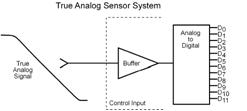
To understand the ultimate resolution of a given sensor, it is necessary to understand how the device functions to generate the analog output. In a true analog sensor, the output is developed by purely analog circuitry, without the use of a digital-to-analog converter. In a true analog sensor, the output change is continuous and infinitely variable. In theory the resolution is infinite, but in practice it is not. Read on to find out why.
Factors Affecting True Analog Resolution
In sensors delivering a true analog output, practical resolution is determined primarily by:
The noise on the output and/or signal lines
The input resolution of the device to which the sensor is connected
Output/signal noise
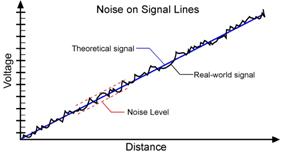
This is the main limiting factor in most measurement systems. Even if the resolution of the sensor is theoretically infinite, it’s only possible to resolve signal changes that are larger than the amount of noise on the output signal lines. Output changes smaller than the noise level are “lost” in the noise.
Controller input resolution
Analog inputs on industrial controls must digitize an analog signal in order to use the information. This is accomplished using an analog-to-digital converter (ADC). An ADC accepts the analog signal and assigns a discrete, digital value to defined signal values. For example, a 12-bit ADC can represent a 0...10 V signal as any one of 4,096 “numbers” (2^12 = 4,096).
Determining Sensor Resolution – A Practical Example
Sensor Type: Magneto-Inductive Linear Position Sensor
Measurement Length: 60 mm (2.36″)
Output Range: 0-10 Vdc
System Noise Level: 10 mV
In this example, the infinitely variable output signal of the sensor is limited by the fact that there is 10 mV of noise present on the signal lines. Since 10 mV is 1/1000th of the entire 0-10V range, the smallest position change that can be detected is 1/1000th of the working stroke range of 2.36”: 2.36 / 1000 = 0.00236”
So a good, practical estimate of the resolution is 0.0024”. Assuming a lower noise level would result in a better estimated resolution, e.g., 5 mV = 0.0012”.
Using a 12-bit ADC in this example gives this ideal input resolution: 2.36” / 4,096 = 0.00058”. But it's important to note that the ADC's resolution doesn't overcome the noise in the system. The limitation resulting from noise is still the determining factor.
So even though the input resolution can be as small as 0.00058” from the ADC, the 10 mV noise level would still limit the sensor's practical resolution to 0.00236”.
Keywords
- Basics of automation
Author

Scott Rosenberger
11 Contributions