

Fixed Focus or Autofocus for Industrial Code Reading
When fixed focus is enough and when autofocus pays off

Reading Time: minutes
TL;DR

· Fixed focus is usually the better choice when working distance is stable and the required depth of field can be covered.
· Autofocus is useful when product heights or reading distances vary significantly.
· For moving parts, autofocus settling time must fit within the available read window.
· The right choice depends on working distance, depth of field, and line speed, not on maximum lens flexibility.
How do fixed focus and autofocus work?
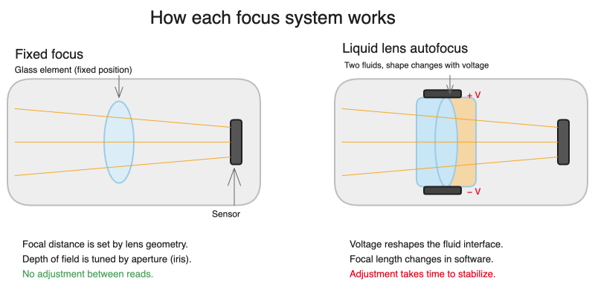
Fixed focus: A lens element is positioned so a defined working distance is in sharpest focus. Depth of field determines the range that remains acceptably sharp. With an adjustable iris, stopping down increases depth of field but reduces the light reaching the sensor.
Autofocus: Modern industrial code readers commonly use a liquid lens. Voltage changes the shape of a fluid-filled optical element, allowing the focal distance to change without mechanical lens movement. A processor selects the target distance and the lens adjusts through software.
Both approaches work. The application determines which one fits.
A code does not have to be perfectly sharp
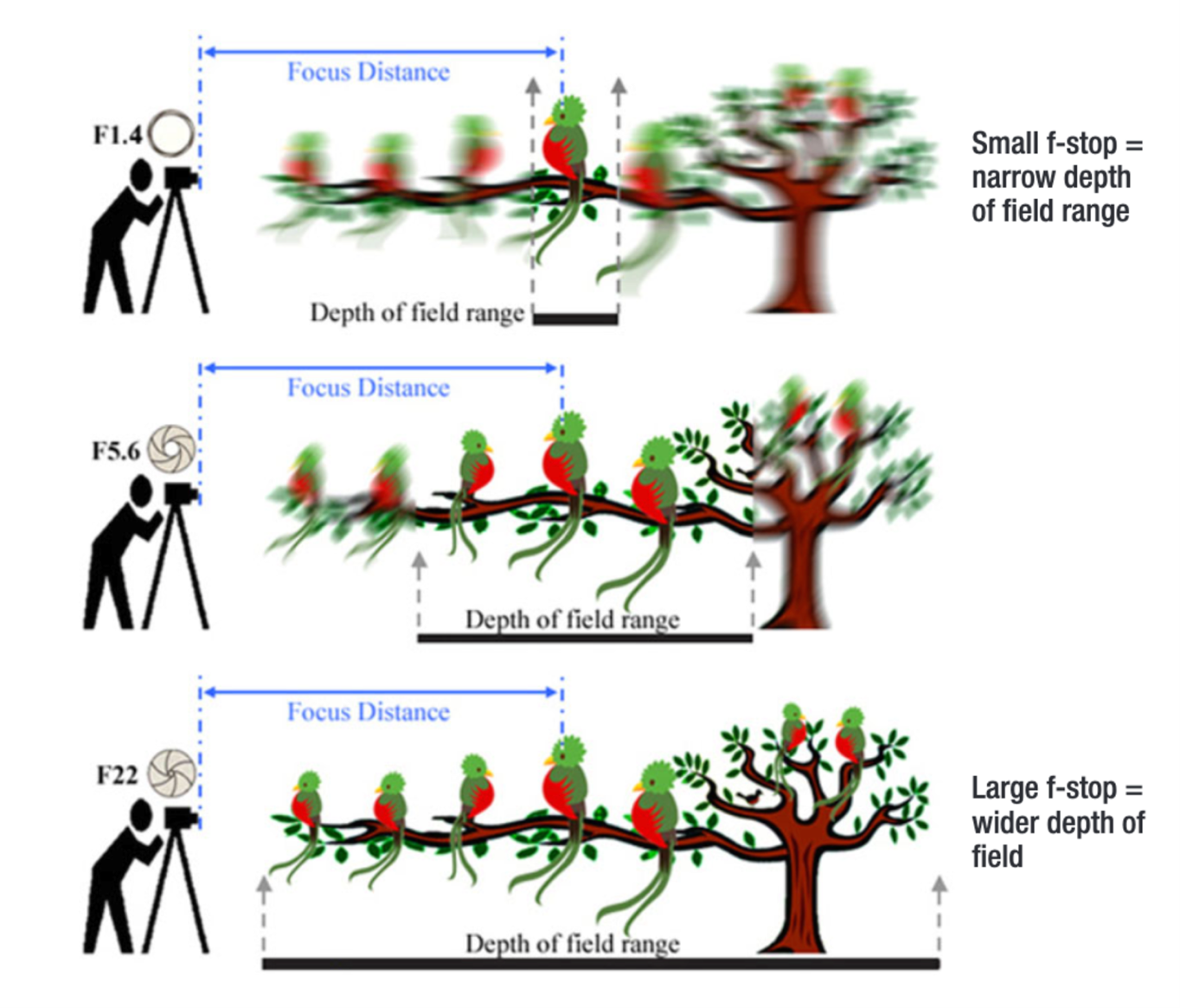
Barcode decoding does not require a tack-sharp image. It requires enough contrast and image information for the algorithm to distinguish bars, spaces, or cells. Slightly soft focus can still provide reliable reads and may smooth print defects, glare, or surface texture.
The practical target is reliable decoding throughout the required working range, not maximum sharpness in every frame.
How stable is the working distance?
If products consistently pass the reader at the same distance, fixed focus is usually the simpler and less expensive choice. Once adjusted, nothing needs to refocus between reads.
Autofocus becomes valuable when working distance changes significantly, for example on multi-SKU lines with different product heights, in tote scanning, with pallets at different stack levels, or where the final mounting distance is difficult to predict.
Start with the application’s actual distance variation, not with the maximum flexibility the lens offers.
How much depth of field do you need?
An adjustable C-mount lens provides another option before autofocus becomes necessary: tune the depth of field. Stopping down the iris increases the range that remains acceptably sharp. Opening it admits more light but reduces that range.
A well-selected fixed-focus lens can therefore cover more variation in product height than its name might suggest. Liquid-lens systems address changing distances by refocusing, which introduces another consideration: time.
Is the part moving while you read it?
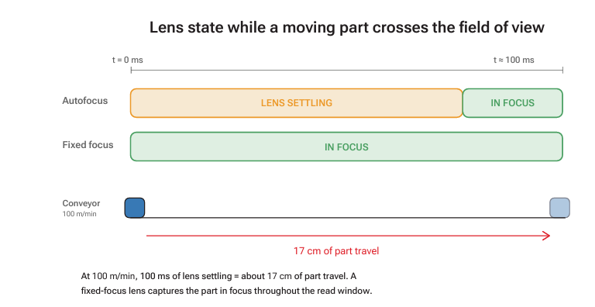
For moving products, autofocus settling time can become important. After a focus change, a liquid lens needs time to reach the requested focal state. If the image is captured too early, the part may not yet be sufficiently focused.
Fixed focus has no refocusing delay. At the tuned working distance, it is ready whenever the image is captured.
Worked example: At 100 m/min (330 ft/min), a product travels about 17 cm (6.6 in) in 100 ms. If refocusing occurs inside the read window, that movement must be included in the timing calculation.
This does not make autofocus unsuitable for fast lines It means focus time, conveyor speed, trigger position, and read-window length need to work together.
Fixed focus or autofocus: which should you choose?
Choose fixed focus when | Choose autofocus when |
working distance is stable | working distance changes substantiall |
available depth of field covers product variatio | multiple product heights must be handled |
consistent timing and repeatability are priorities | reading occurs at several distances |
a simpler optical setup is preferred | physical lens adjustment is impractical |
frequent changeovers justify automatic refocusing | |
the read window provides enough time for focus adjustment |
The trade-off is straightforward: autofocus provides flexibility when the application changes; fixed focus provides simplicity when it does not.
Takeaway
Do not choose autofocus simply because it handles more variation. First determine the actual working-distance range, required depth of field, line speed, and available read window.
If a fixed-focus lens covers that operating range reliably, additional focusing capability adds little value. If the application genuinely requires multiple reading distances, autofocus can solve a problem fixed focus cannot.
Choose the lens that matches the job.
Discover more about our related technologies and products:

Comment
Popular posts
An easy way to remember PNP and NPN sensor wiring
Real-time speed of IO-Link wired
Advantages of inductive proximity sensors in industry
Automation for intralogistics: a practical perspective
Contact form
Do you have any questions or suggestions? We are at your disposal.
Balluff GmbH
-
Zabergäustraße 8
73765 Neuhausen a.d.F.