

Choosing the Right Network Switches in Automotive Manufacturing
When to Use Unmanaged vs. Managed Industrial Ethernet Switches
Reading Time: minutes
In the modern automotive manufacturing environment, data is every bit as critical as the steel, aluminum, plastics, and electronics that move through the plant every day. From robot weld cells to vision-guided assembly, from torque tools to press operations, reliable communication networks underpin nearly every production process. As manufacturers push toward greater automation, traceability, and system interoperability, understanding how to design the right industrial Ethernet architecture becomes a strategic advantage.
A foundational part of that architecture is the correct selection between unmanaged and managed Ethernet switches. Choosing the right type can greatly influence network stability, troubleshooting speed, long‑term scalability, and overall equipment effectiveness (OEE). Automotive manufacturers—who operate some of the most sophisticated, uptime‑critical environments in the world—stand to gain significantly from making the right switch choice for each application.
This article explores when to use unmanaged switches vs. managed switches, tailored specifically for automotive production systems. We’ll examine how each type works, their advantages, and use‑case examples tied to real‑world automotive scenarios.
The Role of Industrial Ethernet in Automotive Manufacturing
Industrial Ethernet has become the dominant communication backbone connecting PLCs, sensors, actuators, vision systems, welding controllers, robots, and more. Automotive plants rely on deterministic, high‑speed data flow to achieve cycle‑time precision and maintain the reliability expected from just‑in‑time (JIT) and just‑in‑sequence (JIS) production models. According to internal Balluff networking guides, Industrial Ethernet's robust physical layer and high‑speed throughput have driven exceptional global growth because it enables continuous communication down to the sensor and actuator level.
To support such networks, manufacturers have access to two primary categories of industrial switches: unmanaged and managed. While both provide fundamental connectivity, they differ greatly in capabilities and the scenarios where they should be applied.
What Are Unmanaged Switches?
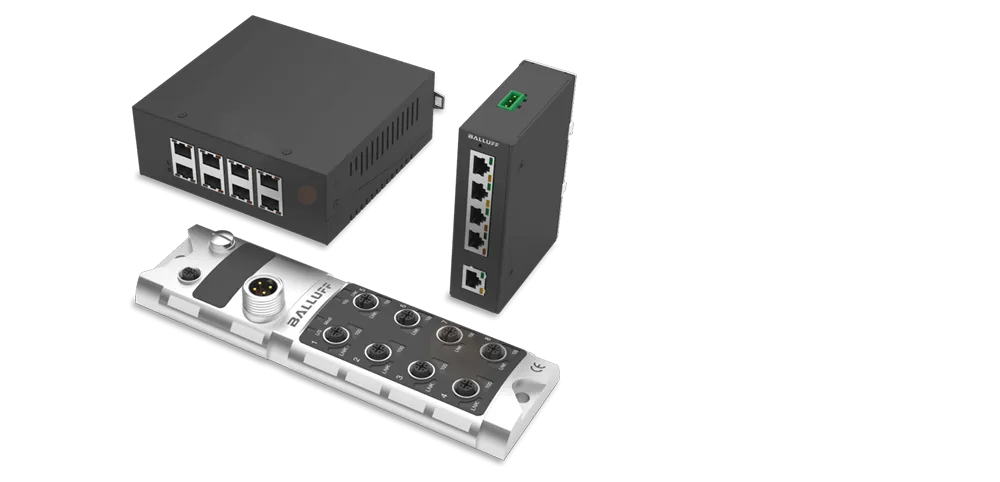
Unmanaged switches provide essential Ethernet connectivity with no need for configuration. They are plug‑and‑play devices designed to forward network traffic transparently.
Key Characteristics:
Require no configuration and do not receive an IP address
Support auto‑negotiation for speed and duplex
Utilize standard Layer 2 forwarding, allowing all protocols to pass through
Offer ruggedized versions with IP67/IP20 housing for harsh environments
Automatically detect cable types through auto‑crossing, reducing wiring errors
Many automotive environments still rely heavily on unmanaged switches for smaller machines or standalone equipment modules, particularly where cost and simplicity drive the decision.
What Are Managed Switches?
Managed switches provide the same basic switching as unmanaged devices, but add powerful tools for network configuration, segmentation, diagnostics, and performance control.
VLANs
Diagnostic relays
IGMP snooping
Port mirroring
Monitoring & lockout
Spanning Tree Protocol (STP/RSTP)
Quality of Service (QoS)
Security features
These features allow IT, controls, and maintenance teams to build resilient networks that can handle the complexity of modern automotive systems.
When to Use Managed Switches in Automotive Manufacturing
1. High‑Traffic Networks with Multicast (Vision Systems, AOIs, Robotics)
Automotive lines depend heavily on vision systems for:
Surface inspection
OCR/OCV
Presence/absence checks
Dimensional verification
Vision systems generate large volumes of multicast traffic. IGMP snooping, available only on managed switches, is essential to keep this traffic from overwhelming the network.
2. Large Production Lines with Long Runs and Many Nodes
Areas like body shop, underbody assembly, final assembly, and paint typically involve:
Dozens of robots
Hundreds of sensors
Multiple controllers
Safety and production networks in parallel
Managed switches enable:
VLAN segmentation
Prioritization of safety and critical traffic
Loop protection via RSTP
Predictive troubleshooting
Without this, a single broadcast storm can take down an entire zone.
3. Automotive Traceability Systems
Traceability is non‑negotiable in the industry. Systems must reliably handle:
RFID readers
Barcode cameras
Torque tools
Press monitoring systems
Managed switches provide the monitoring and diagnostic tools to maintain consistent plant‑wide connectivity.
4. Safety Networks
CIP Safety, Profisafe, and other safety protocols require:
Deterministic communication
Traffic isolation
Redundant paths
Managed switches provide QoS and path protection features that unmanaged switches cannot.
5. Remote Troubleshooting & Maintenance
Port monitoring, event logs, and mirrored traffic allow controls engineers to:
Capture packets
Diagnose intermittent issues
Identify cable breaks
Detect power loss
Find misconfigured devices
Automotive uptime targets often exceed 98–99%, making such diagnostics indispensable.
Unmanaged vs. Managed: Side‑by‑Side for Automotive
Requirement | Unmanaged Switch | Managed Switch |
Low cost, simple machine wiring | ✔ Ideal | |
Harsh environments (IP67) | ✔ Available | ✔ Available |
No configuration needed | ✔ | |
Vision systems & multicast | ✔ Required | |
Safety networks | ✔ Required | |
Large‑scale body shop lines | ✔ | |
Troubleshooting & remote diagnostics | ✔ | |
VLAN separation (safety vs non‑safety) | ✔ | |
Future scalability | Moderate | Excellent |
Keywords
- RFID
- Industrial network technology
- IO-Link
- Industry 4.0
- Sensor technology
- Robotics
- Basics of automation
- Industrial automation
- Technology trends
- Connectivity
- Message Queue Telemetry Transport (MQTT)
- Internet of Things
- Condition monitoring
- Distance measurement
- Flow measurement
- Machine vision
- Intralogistics
- Inductive sensors
Author

John Takacs
Global Key Account Manager Automotive OEM, 25+ years of Automation Sales, Account Management and large project management with Machine builders and Automotive Manufacturing
12 Contributions