

The Humanoid Robotics Paradox
More Flexible Robots Lead to More Design Constraints
Reading Time: minutes
If humanoid robots are slower, more expensive, and less reliable than traditional industrial robots, then why are manufacturers investing billions of dollars? In short, humanoid robotics are focusing on addressing an unsolved problem.
Traditional robots excel at highly repetitive tasks. They deliver speed, precision, and consistency in constrained environments designed for automation. At the same time, they struggle with variation, either in the task or the environment, which is often designed around people, not machines. Humanoid robots will be the automation generalists while industrial robots can remain the specialists.
The Reality Today
Manufacturing facilities are still built around humans. They have stairs, ladders, doors, hand tools, and workstations that allow a person to move and adapt to whatever the situation requires. Rebuilding entire factories around conventional automation is impractical, not to mention ludicrously expensive. Humanoid robots will be designed for the environment instead of redesigning the environment around the robot. That flexibility also makes them incredibly difficult to design.
Flexibility Creates Complexity
The generalist requirements of a humanoid robot demand complex solutions not just in software and AI, but almost every aspect of machine design. It must navigate changing environments, maintain balance, manipulate a wide range of objects, interact safely with people, and switch between tasks with minimal reconfiguration.
More flexibility requires more joints. More joints require more sensors, components, weight, processing, wiring, diagnostics, and control. Any improvement in capability compounds in the overall design complexity. This creates a paradox: The more flexible a robot becomes, the more constrained its design becomes.
Every Joint Matters
One of the clearest examples is motion control. A traditional industrial robot (e.g. articulated robot) may perform a single task using a relatively limited number of controlled axes. A humanoid robot must coordinate movement throughout its fingers, wrists, elbows, shoulders, ankles, knees, waist, and torso while maintaining balance and adapting to its surroundings. Each joint requires accurate position feedback and is dependent on the other joints. Human proprioception comes hard coded. Humanoid proprioception is hard to code.
Even the choice of position feedback technology introduces tradeoffs. Incremental feedback systems require a homing sequence upon startup, while absolute feedback systems always retain position information. In a machine with only a few axes, homing may be a minor inconvenience, but in a humanoid robot with dozens of joints, eliminating homing sequences can significantly reduce startup time and system complexity.
The challenge isn't simply adding more and better sensors. It’s doing so while meeting a long list of competing design requirements. Every design decision affects something else:
Confined spaces: Devices must fit in spaces resembling human limbs and joints
Impact: Devices must withstand standard industrial environmental hazards like a traditional robot, new environmental hazards that traditional robots don’t access, and trips/falls/crashes from moving around
Weight: Devices must be lightweight because every gram increases power consumption, reduces battery life, increases inertia, and increases impact
Contamination: Industrial environments involve dust, liquid, temperature and exposure to other contaminants
Power: Mobile automation cannot draw power from a nearby control cabinet. They carry their own energy source and must balance weight, power consumption, thermal regulation
AI Doesn't Eliminate Hardware Constraints
Artificial intelligence is helping solve many of the software challenges associated with humanoid robotics. Large data sets, simulation environments, and machine learning models are enabling robots to learn new tasks faster, adapt to changing conditions, and operate with greater autonomy than traditional automation systems. Like the development of autonomous vehicles, the goal is not simply to execute a predefined program, but to react intelligently to an unpredictable environment.
However, even the most advanced AI model cannot overcome poor hardware. No matter how sophisticated the software becomes, humanoid robots still depend on accurate position feedback, reliable actuators, robust mechanical systems, and efficient power management. The physical world continues to impose constraints that software alone cannot solve. In many ways, advancements in AI increase the importance of hardware. The more adaptable the robot becomes, the more critical it is that the underlying hardware provides reliable data.
Designing for the Real World
Safety and reliability are also elevated concerns. ISO 25785-1 is a draft under that specifies safety requirements for dynamically stable industrial mobile robots (legged, wheeled, or other forms of locomotion).
Traditional industrial robots typically operate within clearly defined work cells. Humanoid robots are expected to move through dynamic environments. Losing position, unexpected motion, or a fall can have consequences beyond equipment damage. These systems may be handling tools, moving materials, or performing tasks in areas occupied by human workers.
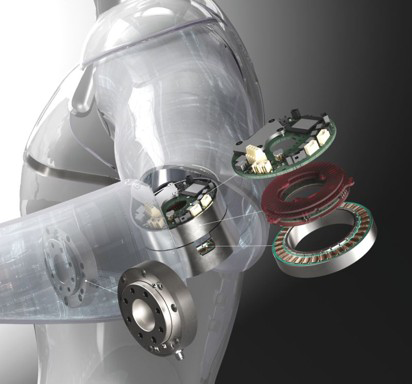
This is one reason technologies like magnetic encoders are receiving attention in humanoid robotics applications. Engineers are evaluating solutions that balance compact size, durability, contamination resistance, and reliable position feedback within the unique constraints of humanoid designs.
The Future Factory Isn't Humanoid-Only
Despite the excitement surrounding humanoid robotics, the future of manufacturing is unlikely to be dominated by a single type of robotics automation.
Instead, factories will likely contain a mix of technologies, including industrial robots, collaborative robots, autonomous mobile robots (AMRs), humanoid robots, and human workers. Each is optimized for a different set of tasks.
Humanoid robots are unlikely to replace traditional automation where highly optimized robotic systems already perform effectively. Their value lies in applications where adaptability matters more than absolute speed, precision, or throughput. That brings us back to the paradox.
The very flexibility that makes humanoid robots appealing is also what makes them difficult to build. Every new capability adds new constraints in sensing, motion control, power management, safety, and mechanical design.
The challenge isn't simply making robots more human. It's making human-like flexibility practical.
Keywords
- Efficient production
- Industry 4.0
- Sensor technology
- Robotics
- Industrial automation
- Technology trends
- Distance measurement
- Intralogistics
Author

Austin Sirkin
Austin Sirkin is the Product Marketing Manager for Positioning and Photoelectric sensor technologies. With more than a decade of sales experience in hardware and system integration, he now collaborates with manufacturers, integrators, and OEMs alike to solve the most complex and challenging sensor applications.
4 Contributions