

All IO-Link is the same. Right???
A common question about the ability to swap IO-Link Masters and IO-Link Devices.

Reading Time: minutes
Is All IO-Link Really the Same? Demystifying the Standards and Vendor Differences
In the world of industrial automation, IO-Link has established itself as a powerful, rapidly expanding network protocol. Its application footprint grows daily, pushed forward by innovations from the IO-Link Consortium like IO-Link Wireless and IO-Link Safety. Yet, as the ecosystem expands, a common question arises: What is actually the same across different manufacturers, and where do they diverge?
The Core Common Ground
At its foundation, IO-Link relies on a strict set of shared physical and electrical standards. No matter which vendor you choose, every IO-Link Master and Device shares a universal DNA:
Physical Connectivity: Connections are strictly limited to M12, M8, or M5 port types , utilizing standardized 3-, 4-, or 5-conductor cables with a strict maximum cable length of 20 meters.
Power and Signaling: The architecture runs entirely on 24 volts DC for both power and data transmission. The underlying communication relies on a UART 24-volt pulse-width modulated signal on Pin 4, using Pin 3 (0 volts) as its steady reference.
Data Rates: Every device is built to communicate using one of three standard baud rates: Com 1 (4.8 kbaud), Com 2 (38.4 kbaud), or Com 3 (230.4 kbaud).
Ultimately, this baseline hardware connection between a master port and a device is the only true universal commonality you will find across the market. Beyond these physical layer rules, vendors have plenty of room to differentiate.
 Where Vendors Diverge
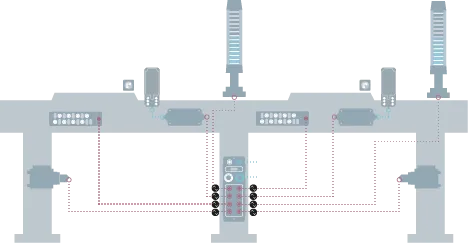
When evaluating IO-Link Masters, the variations from one manufacturer to the next come down to how they handle higher-level integration and port dense environments. Vendors differentiate themselves through their upper-level protocol connection options—such as EtherNet/IP, Profinet, EtherCAT, or Modbus TCP. You will also find differences in the physical number of ports available , the specific mix of M12, M8, or M5 port types on the block , the depth of diagnostic capabilities , the internal process data layout , and the exact methods used to adjust device parameters.
On the flip side, IO-Link Devices (sensors and actuators) introduce their own set of variables. While they must use standard connectors and conductors , devices vary wildly in their overall process data size and which of the three standard baud rates they actually utilize. Furthermore, the granularity of available diagnostic data and unique, vendor-specific events change significantly from one device to the next.
Navigating the Ecosystem
If this level of variation feels daunting, the best advice is simple: don't panic. The beauty of IO-Link is that this diversity translates into an incredible wealth of application options.
Vendor differences are nothing new in industrial automation. Veteran automation professionals will remember the days of valve manifolds using 25-Pin D-Sub connectors, where manufacturers intentionally swapped the 0-volt common pin location just to prevent easy hot-swapping between brands. Compared to those legacy headaches, IO-Link’s standardized foundation is a massive leap forward.
The key is simply to do your research. Approach your system design by choosing a master vendor and specific IO-Link devices that precisely align with your unique application needs. This flexibility shouldn't discourage you from adopting the technology —it is exactly what allows us to keep pushing boundaries and growing IO-Link's dominance in the global automation market.
Keywords
- Industrial network technology
- IO-Link
- Industry 4.0
- Industrial automation
- Technology trends
Author

John Harmon
A 26-year veteran of the industrial automation space, he combines hands-on technical instruction with product management expertise and high-level technical sales support to drive innovative industry solutions.
22 Contributions