

RoCEv2 and the path to 100GigE
How the industry moves beyond classic 1GigE toward ultra‑fast 100GigE architectures

Reading Time: minutes
1GigE has been, and remains, a useful and convenient camera protocol, allowing long, industrial cables and easily-managed multi-camera or multi-host systems in a familiar interface without proprietary technology – switches, network interface cards are available from many vendors with many configurations to suit different applications.
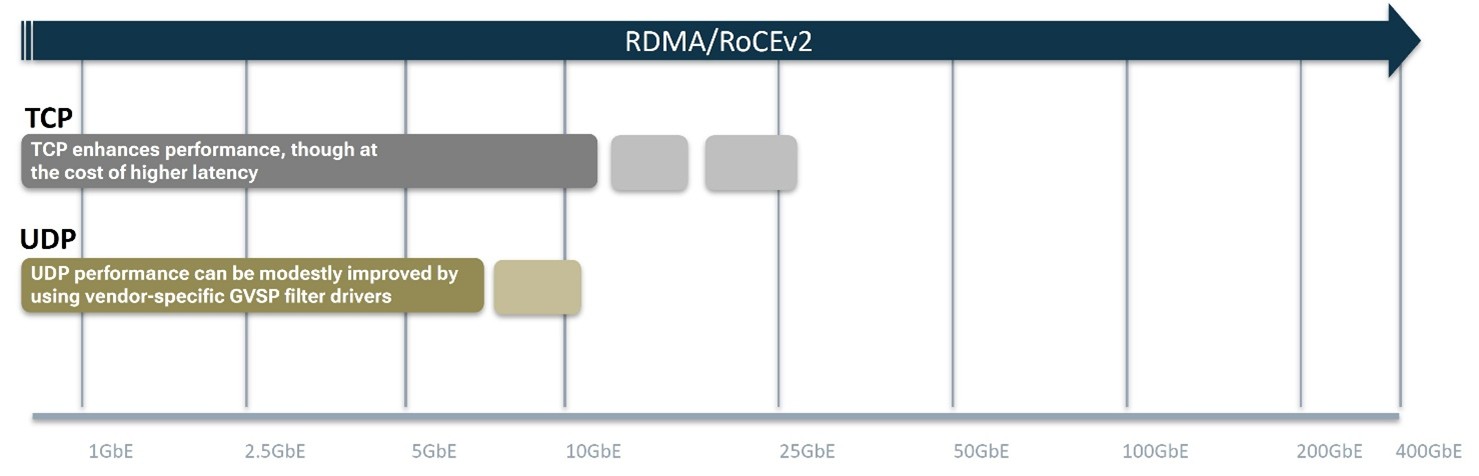
Over time the requirement for more data has meant that dual GigE, N-BaseT and 10GigE cameras have become widespread. This begins to place demands on the host machines that were not significant with 1GigE. The management of packets and movement of data place increasing requirements on the host’s CPU.
High-speed Ethernet
Systems based on 1GigE to 5GigE cameras have generally had manageable levels of CPU load on the host, with filter-drivers giving an efficient method of dealing with image-packets and jumbo packets reducing the CPU load and increasing the payload-efficiency of the Ethernet links.
With 10GigE cameras we see advantages to DMA (direct memory access) methods to overcome the bottleneck. RDMA (remote direct memory access) is a way to do this over a network, and RoCEv2 allows the data to be routed to manage the bandwidth. With increasing transfer speeds (25 and 100GigE), this becomes an important way to control the network load and the load on the host.
This scalability allows Ethernet-based cameras to compete with the fastest framegrabber-based systems. In the following comparison, we take CoaXPress over Fiber (CoF) as the high-speed benchmark.
RoCEv2 Fundamentals
RDMA means that network data transfers happen with no CPU intervention. This is absolutely different to other Ethernet-based transfers where each packet must be interrogated to find out its source, destination, payload-size and so on. All of these are CPU tasks. With RDMA the CPU load is minimal – less than 1% even at 100GigE speeds. In addition the lack of CPU intervention allows lower latency and makes the interface the limiting factor, not the host’s processing capability. Removing this bottleneck makes high-speed Ethernet cameras a scalable, practical reality.
|
25 or 100GigE |
CoaXPress over Fiber (CoF) system |
Comments |
|
|
Bandwidth |
100GigE interface is 100Gbps, around 99Gbps is usable |
~100Gbps |
Comparable interface speeds |
|
Transmission media |
Fiber cables, QSFP connectors |
Fiber cables, QSFP connectors |
|
|
CPU overhead |
<1% due to RDMA |
Minimal due to DMA |
Comparable CPU overhead |
|
Error-reporting |
Ethernet-based cameras can resend packets, allowing correction even if there is data-loss or corruption on the wire |
Errors can generally be reported, but not corrected. |
|
|
Scalability |
Network architecture allows multi-camera and multi-host. RoCEv2 allows the bandwidth to be routed and CPU-load is not bandwidth-related |
Framegrabber-based systems are point-to-point but splitters do exist |
Flexibility advantage with Ethernet-based systems |
|
Synchronisation |
Hardware triggering on the camera and IEEE1588 PTP for clock-synchronisation of separated devices |
Hardware triggering generally on the camera and on the framegrabber |
|
|
Processing |
There are NICs with FPGA processing on-board. RDMA also facilitates GPU-direct and NVMe-direct workflows |
Many framegrabbers have some processing capability such as Bayer conversion, some have further general processing capabilities |
|
|
CPU overhead for acquisition |
RoCEv2 brings this to a minimal level, around 1% |
Minimal due to DMA |
|
|
Power budget (camera) |
25GigE cameras of the order of 11-13W 100GigE cameras of the order of 18W |
34W estimated |
Lower power in Balluff Ethernet cameras |
|
Power budget (system) |
100GigE NIC typically 10-29W |
30W estimated |
Similar power requirements |
Keywords
- 100 GigE Camera
- Machine Vision and Optical Identification
- Vision
Author

Roman Vracko
4 Contributions
Comment
Popular posts
An easy way to remember PNP and NPN sensor wiring
Real-time speed of IO-Link wired
Advantages of inductive proximity sensors in industry
Automation for intralogistics: a practical perspective
Contact form
Do you have any questions or suggestions? We are at your disposal.
Balluff GmbH
-
Zabergäustraße 8
73765 Neuhausen a.d.F.