

Can a Sensor Tell You It’s Getting Dirty?
How smart sensors can provide early warning before detection fails.
Reading Time: minutes
A sensor doesn’t always go from working perfectly to failing overnight. In many industrial environments, dust, oil, coolant, and other process fluids gradually build up on a sensor’s face. The sensor may continue operating normally until that buildup eventually causes an unreliable or missed detection.
But what if you could identify the problem before that happens?
Looking Beyond ON and OFF
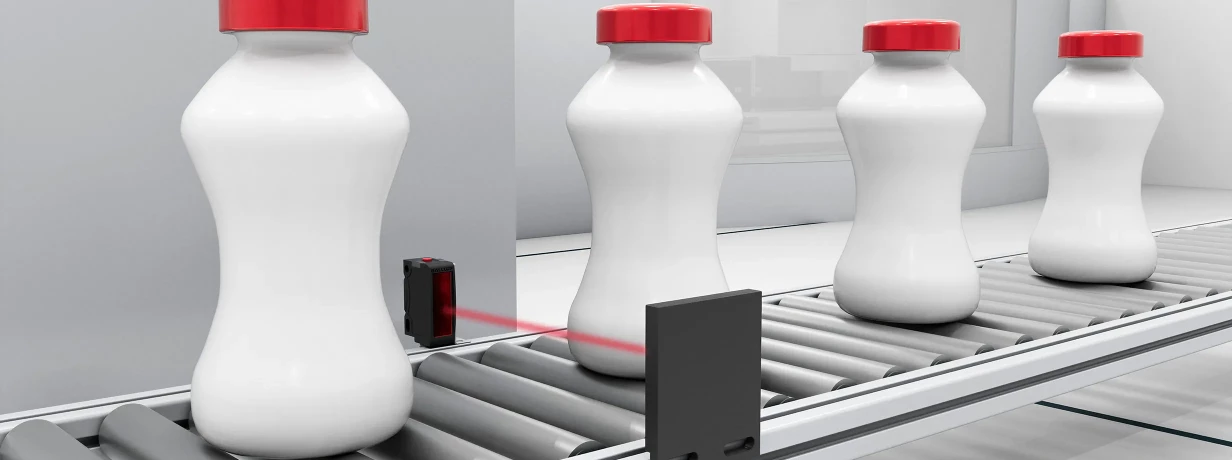
Consider a standard photoelectric sensor detecting objects on a production line. Traditionally, the control system receives a simple signal: target detected or target not detected.
Modern sensors can provide additional information about what is happening between those two states. For example, as contamination accumulates on an optical surface, the amount of light reaching the receiver may gradually decrease even though the sensor continues to switch correctly.
Monitoring this reduction in signal strength can provide an early indication that the sensor is becoming obstructed and may soon require attention.
From Unexpected Downtime to Planned Maintenance
Rather than waiting for contamination to cause a missed detection, a machine can use diagnostic information to alert maintenance personnel that a sensor should be inspected or cleaned.
Technologies such as IO-Link allow compatible sensors to provide additional process and diagnostic data alongside their normal switching signal. The data can then be displayed on an HMI, giving operators greater visibility into the health of their devices.
Imagine an operator looking at an HMI and seeing that sensors 10 and 13 have declining signal quality and should be inspected during the next maintenance window. Instead of waiting for a fault, stopping production, and troubleshooting the issue, maintenance personnel already know where to focus their attention.
Sometimes, a simple early warning is all it takes to turn an unexpected production stop into a routine maintenance task.
Keywords
- IO-Link
- Efficient production
- Sensor technology
- Smart sensor technology
- Condition monitoring
- Optical sensors
Author

Payne Delawder
Payne Delawder is a Chemical Engineering graduate of Ohio University and a Sales Engineer at Balluff. Tackling manufacturing challenges and finding practical ways to make industrial processes smarter and more efficient.
4 Contributions