

Condition Monitoring: Going Beyond Vibration Monitoring
Detect Failures Before They Happen
Reading Time: minutes
 A significant challenge in implementing condition monitoring or predictive maintenance is determining the “best” indicators and signals to monitor for early detection of impending failures. This topic has gained interest in the automation press and at conferences, experts are now advising measurement of multiple asset attributes to detect impending failures sooner. A key reason for this “more indicators are better” approach is that each application is unique, and monitoring a single attribute, most commonly vibration, does not provide a complete equipment health picture and may not offer early warning of an impending failure. Monitoring vibration can work well when motion is involved, but other indicators may be better failure predictors, depending on the application. And monitoring multiple indicators provides a broader early warning solution than monitoring just one factor.
The P-F (Potential - Functional Failure) Curve
To better explain this point, consider the P-F Curve, which is used to visualize the lifecycle of the failure of an asset (for more on the P-F Curve see Identify Failures Before They Happen: The Potential-Functional Curve | Balluff). As equipment ages and deteriorates, various indictors emerge which can be used to predict the impending failure. Depending on the equipment and application, different indicators can provide warning at different times in lifecycle of the failure.
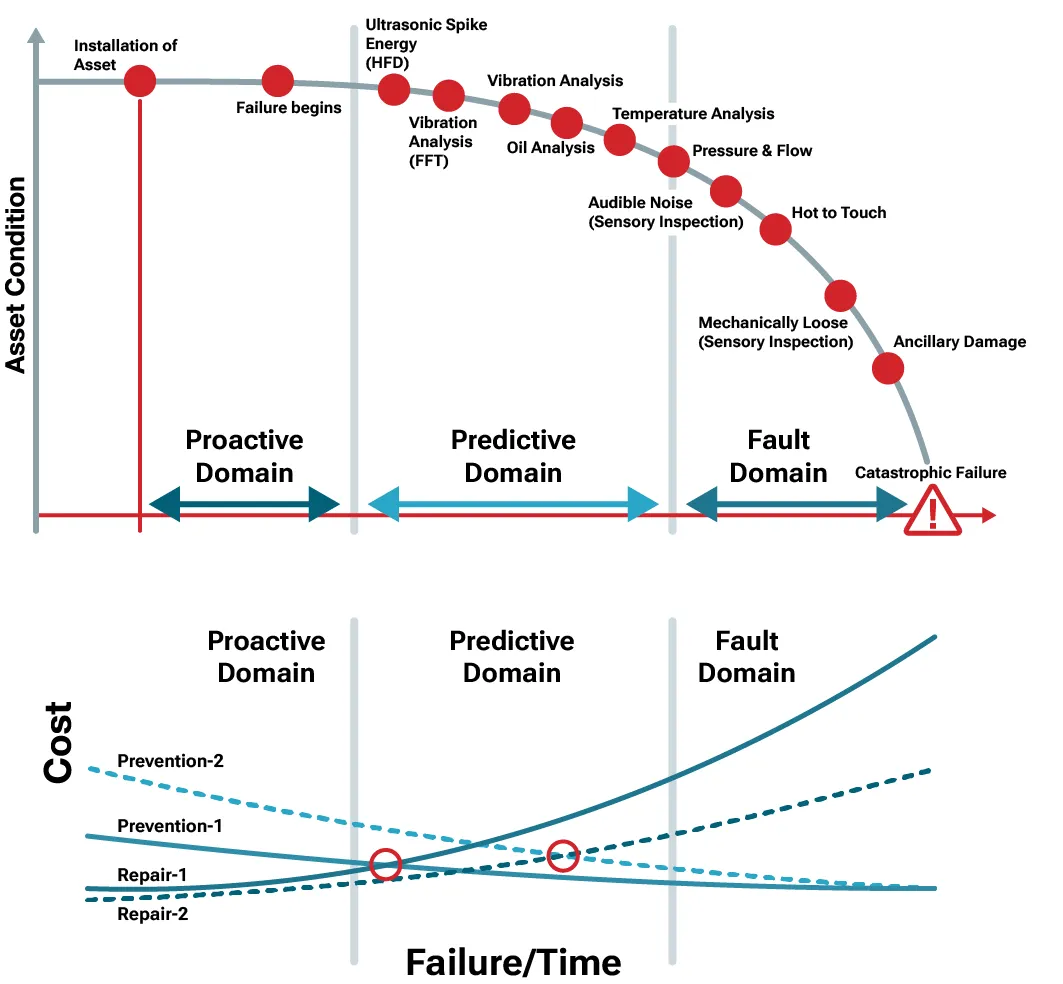 While vibration is generally an excellent early failure indicator in motion applications, it is sometimes masked by normal equipment vibration and frequencies until it is too late to prevent failure. It is, therefore, beneficial to consider additional indicators such as temperature, pressure, flow, speed, voltage/current, torque, inclination, humidity, level, sound, fluid analysis, ultrasound and displacement.
 Monitoring Applications
As a “real-life” example, a hydraulic power unit (HPU) includes motors, pumps, tanks, hoses and various other components, each a possible failure point. Monitoring motor vibration can provide warning of an impending motor failure, but is unlikely to indicate a clogged filter, low/high tank levels or broken hoses. A complete HPU condition monitoring solution should therefore include flow, pressure, level and perhaps power monitoring to generate a comprehensive early warning system.
Similarly, vibration monitoring of a motor on a conveyor, robot or CNC machine tool is a good way to warn of impending failure, but additional signals using temperature, voltage/current, torque and advanced FFT vibration can provide a broader picture of potential problems and much earlier warning that a failure is imminent.
Multiple Signals Enable Advanced Monitoring
Gathering data from multiple indicators is also beneficial when upgrading from condition monitoring to predictive maintenance solutions. The additional signals and data can help machine learning and A.I. tools learn more quickly and more accurately predict failures and avoid “false positives.”
While vibration is the most monitored indicator, there is a significant benefit to adding on monitoring of temperature, pressure, flow, voltage/current and other attributes. Applying more than one type of condition monitoring sensor allows a better understanding of equipment condition and enables earlier detection of potential failures.
Keywords
- Industrial network technology
- IO-Link
- Efficient production
- Industry 4.0
- Sensor technology
- Basics of automation
- Industrial automation
- Technology trends
- Smart sensor technology
- Internet of Things
- Condition monitoring
- Flow measurement
Author

Tom Knauer
Tom Knauer has more than 30 years of industrial automation experience and has presented on condition monitoring and smart manufacturing/IIoT at the Automate Conference, the Assembly Show, IMTS and IME West.
37 Contributions