

Simplifying Through-beam Sensors with Built-in Alignment
Fork sensors eliminate alignment challenges with a fully integrated design
Reading Time: minutes
The hidden challenge of through-beam alignment
Through-beam sensors are a strong choice for applications that require long-distance detection or open spans. In shorter, fixed-path applications, the challenge often shifts from distance to maintaining alignment over time. A setup that works perfectly on day one still has to survive vibration, adjustments, and daily operation.
Why alignment is harder than it looks
Real machines don’t stay perfectly still. Vibration, frame movement, and routine changes make it difficult to keep two devices precisely aligned.
What misalignment does to reliability over time
With slight misalignment, through-beams often still work, but with less margin. That reduced margin makes detection more sensitive to vibration, dust, and small mechanical changes, leading to missed detections or nuisance faults.
Designing alignment out of the equation
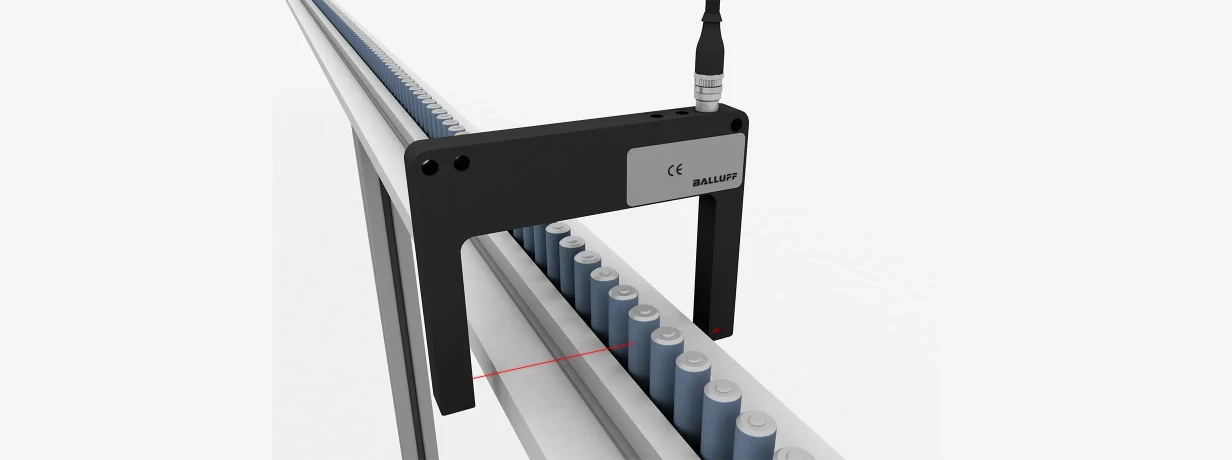
In applications with a fixed sensing gap, alignment does not need to be managed. Fork sensors integrate the emitter and receiver into a single housing, removing alignment drift.
This also simplifies commissioning. Instead of aligning two devices, installation becomes a one-step process with consistent results.
Where alignment stability makes the biggest difference
Alignment stability is critical for:
Small or precise targets
High-vibration equipment
Changing environments
Applications that demand repeatability
Handling challenging mounting conditions
In applications where straight mounting is not practical, angled fork sensor designs provide additional flexibility. They allow the sensing gap to align with the part path without complex brackets or rework, helping maintain reliability in tight or constrained layouts.
Choosing simplicity when alignment matters
Through-beam sensors are a strong choice when you need to cover distance or span open space.
But when the part path is fixed and alignment maintenance becomes the real reliability challenge, fork sensors simplify the application. They reduce setup time, lock alignment in from the start, and help prevent drift caused by vibration, adjustment, or routine maintenance.
Keywords
- Efficient production
- Sensor technology
- Basics of automation
- Industrial automation
- Technology trends
Author

Bella Mayhew
Bella Mayhew is a Biomedical Engineering graduate from the University of Delaware, applying technical problem solving to real-world manufacturing challenges as a Sales Engineer at Balluff in the Northeast US.
5 Contributions