

Connecting IT and OT Through Practical IIoT Architectures
Building secure, scalable pathways from the factory floor to business systems
Reading Time: minutes
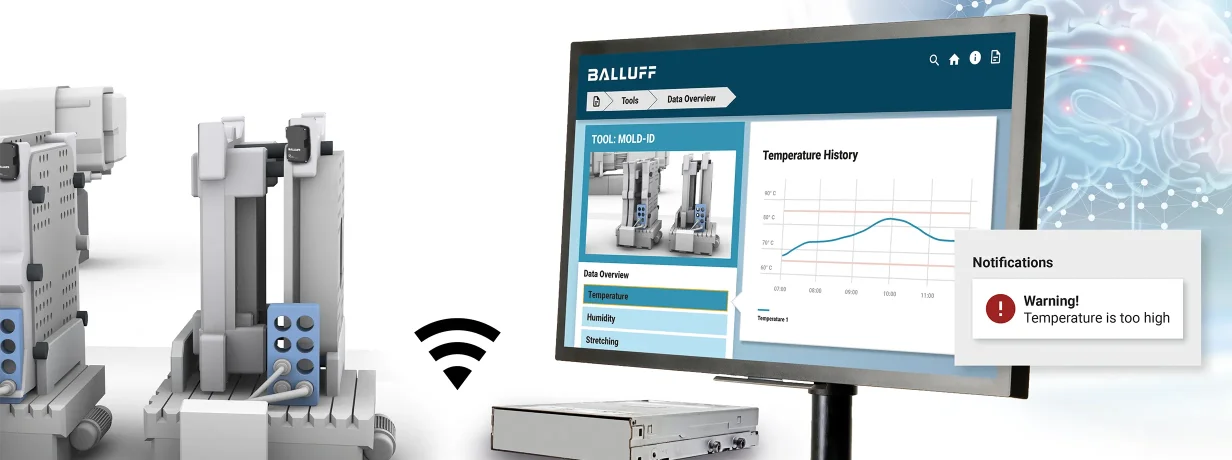
For manufacturers, IT/OT convergence is no longer just a technology discussion; it is a business priority tied directly to uptime, maintenance efficiency, scalability, quality, and faster decision-making.
Practical IIoT architectures make this possible by creating secure, scalable pathways between OT systems on the plant floor and IT systems used for analytics, reporting, and enterprise decision-making.
Historically, OT systems were designed around reliability, determinism, and safety. PLCs, industrial networks, sensors, actuators, and control systems operated within isolated environments to ensure uninterrupted production and minimize operational risk. In contrast, IT systems focused on data accessibility, enterprise software, analytics, databases, and cloud infrastructure. These two domains evolved independently, often with limited communication between them.
The Growing Importance of Industrial Data
The value of IIoT extends beyond connectivity. Its true advantage is the ability to convert machine-level signals into actionable insight for maintenance, operations, quality, and leadership teams.
Traditional automation systems typically provide only basic process information. A conventional sensor may communicate a simple digital state such as on or off, present or absent, or pass or fail. While effective for machine control, this limited visibility does not provide sufficient information for predictive maintenance, root-cause analysis, or long-term operational optimization.
Modern IO-Link enabled devices significantly expand the available data set. In addition to process values, these devices can communicate diagnostics such as signal quality, internal temperature, operating hours, switching frequency, parameter settings, and device health status.
For example, abnormal vibration patterns, gradual temperature increases, or deteriorating signal quality can indicate developing mechanical or electrical issues before a failure occurs. By identifying these trends early, manufacturers can schedule maintenance proactively, reduce unplanned downtime, and improve asset utilization.
In a practical production scenario, this could mean identifying a deteriorating motor or spindle condition during a planned maintenance window instead of discovering it after an unexpected line stoppage.
The Role of Edge Architectures
One of the most effective ways to connect IT and OT environments is by implementing edge architectures.
Edge gateways act as intermediaries between industrial control systems and enterprise-level software platforms. These gateways collect information from PLCs, IO-Link masters, sensors, and industrial devices, then translate the data into IT-friendly communication standards such as MQTT, REST API, and OPC UA.
This architecture provides three important advantages.
First, it allows manufacturers to access operational data without exposing critical control systems directly to enterprise networks or cloud infrastructure. This separation remains essential for cybersecurity, operational integrity, and safety.
Second, edge systems can filter, buffer, and preprocess data locally before transmitting it to enterprise systems. This reduces unnecessary network traffic and allows manufacturers to focus on the most valuable operational information.
Finally, edge architectures support scalability. Manufacturers can expand data collection, analytics, and monitoring capabilities without fundamentally redesigning existing automation systems.
Common IIoT Architecture Approaches
Successful IIoT implementations should begin with the operational objective, not the technology stack. The right architecture depends on whether the priority is real-time machine control, scalable diagnostics, predictive maintenance, or enterprise-wide visibility.
In practice, most deployments align with one of three approaches, each suited to a different level of control dependency and data maturity.
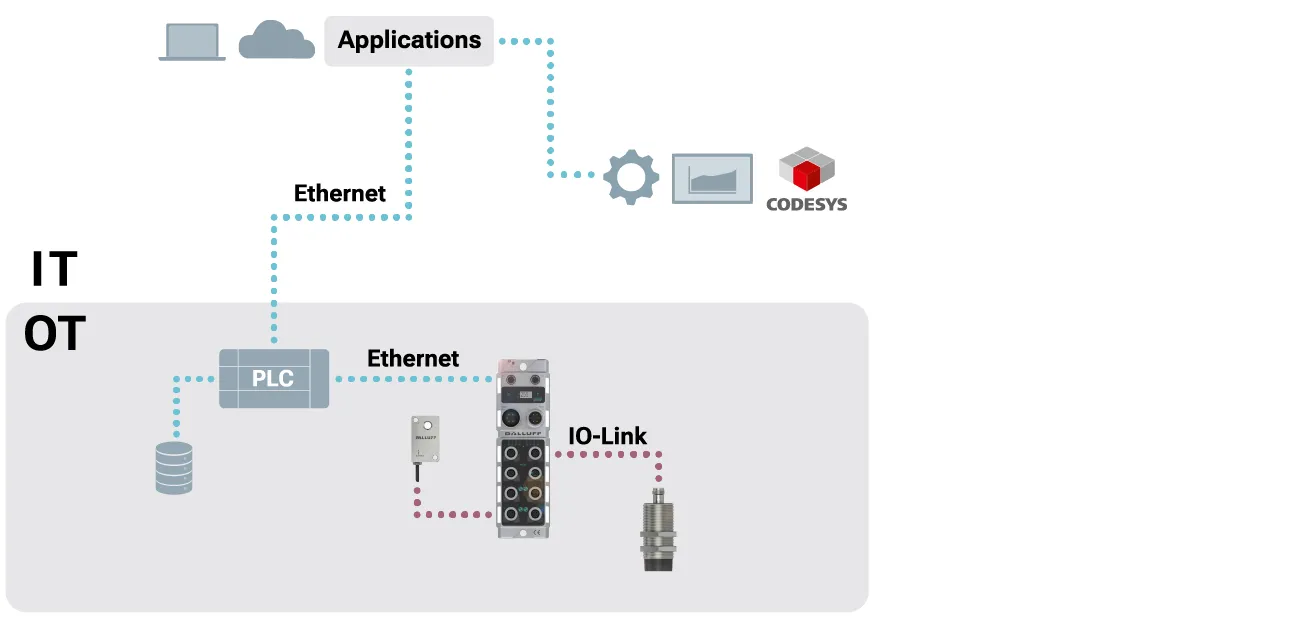
1. Existing PLC-Centric Architectures
In this approach, the PLC remains the primary processing and control platform. Operational data is managed primarily within the automation environment itself.
This architecture is well suited for applications requiring fast cycle times, deterministic control, and tightly integrated machine logic. Because processing occurs directly within the control system, response times remain extremely fast and predictable.
However, accessing detailed service and diagnostic information can be more difficult in these environments. PLC memory limitations and software complexity may also restrict long-term data collection and analytics capabilities.
This approach is best used when machine control performance, deterministic response, and minimal architectural change are the highest priorities.
 2. Extended Architectures with Edge Integration
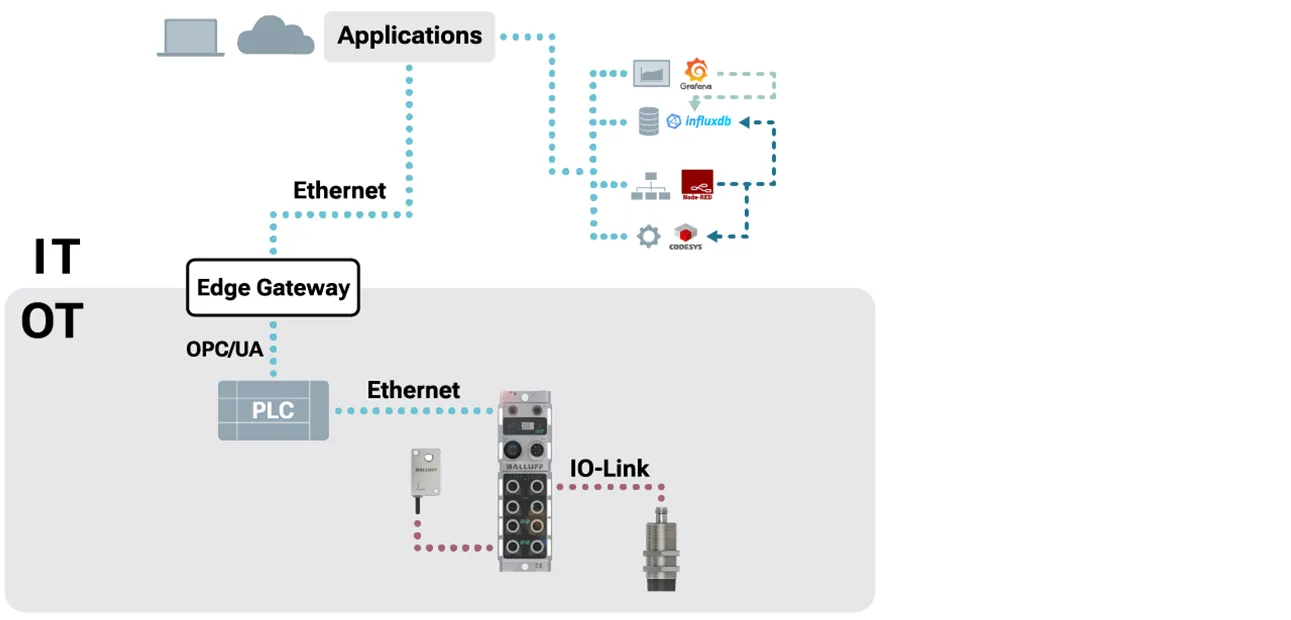
The second approach maintains the PLC as the core machine controller while introducing gateways or software platforms dedicated to diagnostics, analytics, storage, and visualization.
In this architecture, the PLC continues to manage real-time process control while the edge layer handles higher-level operational data.
This model offers a balanced solution for manufacturers seeking both deterministic machine control and modern data accessibility. It enables easier integration with dashboards, MES systems, cloud platforms, and enterprise analytics while minimizing disruption to existing automation infrastructure.
For many manufacturers, this is the most practical path toward IIoT adoption because it preserves OT reliability while enabling IT-level access to valuable production data.
 3. IIoT-Focused Architectures
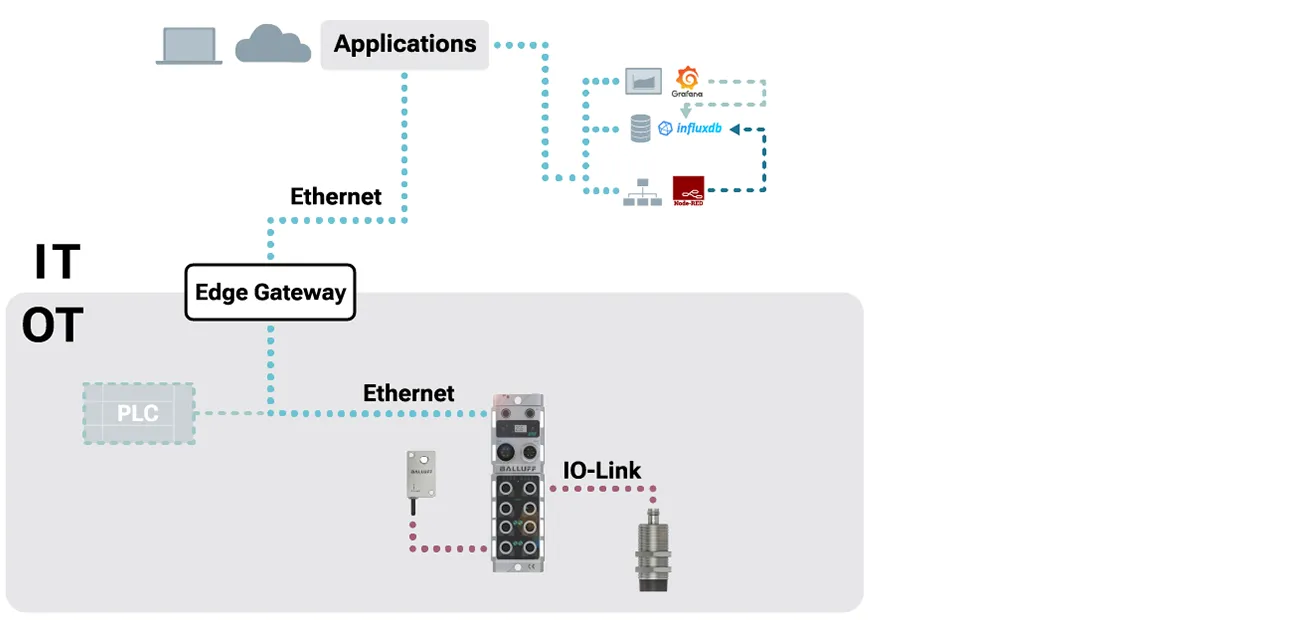
The third approach is designed primarily around analytics, predictive maintenance, and operational intelligence rather than traditional machine control.
In these systems, smart sensors, IO-Link masters, condition monitoring devices, and software applications collect and process large amounts of operational data with limited dependence on PLC logic.
This architecture is particularly effective for applications focused on condition monitoring, asset management, energy analysis, and predictive maintenance.
This approach is best suited when the primary goal is broad operational intelligence, historical analysis, remote visibility, or predictive maintenance rather than direct high-speed control.
 The Importance of IO-Link in Modern Automation
IO-Link has emerged as a foundational technology within modern IIoT architectures due to its ability to standardize communication at the sensor and actuator level.
Unlike traditional digital devices, IO-Link enabled components provide access to both process data and extensive diagnostic information through a standardized communication protocol. This simplifies integration while improving operational transparency.
IO-Link also reduces wiring complexity, simplifies device replacement, and accelerates commissioning. Automatic parameterization capabilities allow replacement devices to be configured rapidly, reducing downtime and minimizing manual setup errors.
These capabilities become increasingly valuable as manufacturing systems grow more distributed, modular, and data-driven.
Distributed Systems and Wireless Connectivity
Modern production environments are increasingly adopting distributed machine architectures. Rather than relying exclusively on centralized control cabinets, manufacturers are deploying machine-mount I/O systems closer to the process.
This trend is especially common in robotics, assembly systems, AGVs, machining centers, and modular production cells.
Wireless industrial communication technologies are becoming important enablers within these environments. IO-Link Wireless allows manufacturers to connect sensors and devices in locations where traditional cabling is difficult, expensive, or operationally limiting.
By reducing mechanical constraints while maintaining industrial-level reliability, wireless architectures support greater flexibility and scalability within modern manufacturing systems.
Strategic Value of IIoT
The strategic value of IIoT comes from enabling better operational decisions, not simply collecting more data. Effective architectures help manufacturers identify inefficiencies earlier, diagnose issues faster, optimize maintenance schedules, and improve overall equipment effectiveness.
Conclusion
The convergence of IT and OT represents one of the most significant developments in modern industrial automation.
As manufacturing systems become more connected, the ability to securely access, analyze, and use operational data will continue to grow in importance. Technologies such as IO-Link, edge computing, predictive maintenance platforms, and distributed architectures are enabling production systems that are not only automated, but also intelligent and adaptable.
Importantly, this evolution does not replace traditional automation principles. Reliability, deterministic control, safety, and uptime remain essential. Instead, IIoT extends these systems by making operational information more accessible and actionable across the enterprise.
Manufacturers looking to close the gap between IT and OT should begin by assessing where operational data is created, how securely it can be accessed, and which architecture best supports their goals for uptime, maintenance, scalability, and enterprise visibility.
Keywords
- Industrial network technology
- IO-Link Wireless
- Efficient production
- Industry 4.0
- Basics of automation
- Industrial automation
- Technology trends
- Message Queue Telemetry Transport (MQTT)
- Internet of Things
- Condition monitoring
Author

Anjesh Shekhar
Anjesh Shekhar is a product marketing manager focused on automation, with experience in IO-Link networking, industrial Ethernet, and modern machine architectures. He works where technology meets the factory floor, helping engineers and manufacturers make practical decisions about connectivity and control systems. His background across sensors, networking blocks, and embedded platforms gives him a clear, grounded view of how real machines run.
28 Contributions