

Future-Proofing Your Automation: Start Simple, Scale Smart with IO-Link
Spec for where you’re going, not where you are
Reading Time: minutes
IO-Link has been widely adopted across manufacturing for years. For most of the customers I work with, the question is no longer whether to use it, but where to use it next.
There is still a group that has not made the move, though, and their reasoning is almost always the same:
“We’re interested in IO-Link, but we’re not ready to use all those advanced features yet.”
That is a fair place to be. It is also based on an assumption worth challenging, because specifying IO-Link today does not commit you to using any of it tomorrow.
Spec’ing Today Doesn’t Mean Using It Tomorrow
In most cases we can specify something that drops in functionally one-to-one with the simpler device it replaces, while leaving room to grow without a hardware change later.
The device installs the same way. It behaves the same way. Your controls engineers and maintenance techs interact with it the same way. Nothing about the daily reality of the machine changes on day one.
What changes is what is sitting underneath, waiting until you want it.
What you use on day one | What is already there when you’re ready |
Standard discrete I/O handling | Process data, measurement values, and device identity |
Familiar wiring and installation | Bidirectional communication for parameters and configuration |
Manual setup at the device | Automatic device replacement with stored parameters |
No visibility beyond working or not working | Diagnostics, event data, and power consumption monitoring |
Data stays at the control layer | A path to SCADA, MES, edge platforms, and analytics |
Future-proofing is not about predicting the future. It is about avoiding decisions that limit your options later. The goal is not to use every available feature on day one. The goal is to make sure the hardware you install today does not become the thing that holds you back tomorrow.
A Concrete Example
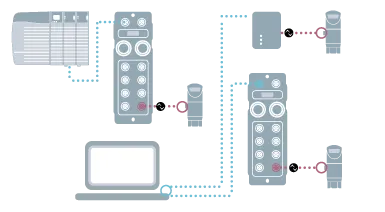
Take advanced line IO-Link hubs with built-in power and condition monitoring. There is a lot of capability under the hood, but none of it is required to get a machine running. You can spec and install them handling nothing but standard I/O, and they demand no more upfront effort than a simpler block would.
I've seen this play out with customers who initially deployed IO-Link hardware strictly for basic machine control. At the time, there was no plan to use diagnostics, condition monitoring, or advanced parameterization. Later, when troubleshooting recurring issues or looking for ways to reduce downtime, they already had the infrastructure in place. Instead of replacing hardware and rewiring machines, they were able to start pulling data from devices that had been there all along.
The value shows up later. When your team has the bandwidth, or a requirement lands that means you need to start pulling diagnostics, watching power consumption, or building out condition monitoring, the infrastructure is already installed. No part replacement. No rewiring. You start turning on capabilities and reading information that had simply been sitting there unused.
What About Price?
The premium varies depending on the device and application. In some cases it is significant. In others it is surprisingly small. Sometimes the premium for the extra capability is significant. Sometimes it is barely more than the simpler alternative. It is worth comparing case by case, and it is a conversation I am always happy to walk a customer through.
The more important comparison is not the price difference between two devices today. It is the cost of replacing one later. The expensive version of this decision is tearing out standard devices two years from now and paying for the downtime, rewiring, validation, and engineering hours that a different specification could have avoided.
What About Parameterization?
This is the other objection I hear, and I understand it. Parameterization sounds complex and it can feel intimidating from the outside.
For most people getting started, it is not something you need to tackle on day one. The device works without it. When you are ready, particularly for automatic device replacement, it mostly comes down to deciding on your preferred approach and doing a little planning up front.
 Why This Matters More Than It Used To
Nearly every plant leader is now being asked what their AI or analytics strategy looks like. Those conversations tend to skip an uncomfortable prerequisite: analytics and models need history, and you cannot analyze data you never collected.
To me, that is the strongest argument for future-proofing. The device you specify today is not only serving the machine in front of you. It is determining whether you have anything to work with when someone asks a harder question in two years. Basic mode on capable hardware still builds that foundation. Basic mode on hardware that was never capable builds nothing.
Stop spec’ing for where you are today. Start spec’ing for where you’re going.
Keywords
- IO-Link
- Industrial network technology
- Industrial automation
- Basics of automation
- Condition monitoring
- Sensor technology
Author

Kyle Bause
Kyle is a Product and Application Specialist at Balluff, where he works directly with manufacturers on sensor, IO-Link, and industrial connectivity applications. He spends most of his time on plant floors helping teams match technology to what their operations actually need.
32 Contributions